Architect of Atmosphere: The Genesis of Love Spirals Downwards
Long before Love Spirals Downwards became the “Darlings of Projekt,” Ryan Lum had already been patiently building the sound that would eventually shape the project’s identity. To understand the atmosphere of Idylls, one needs to first explore the years of solitary work that preceded it. The project’s character emerged less from a traditional band dynamic than from Lum’s developing home-recording practice and his growing philosophical interests.
The Architect of Sound
Lum created music throughout the 1980s in private, approaching it as a personal creative outlet. Reflecting on this period in Fond Affexxions (1993), he said: “I just made music. It’s been an important pursuit of mine over the past several years, but I never had any intention of pursuing music as a sort of career, on a professional level. I just always made music for myself. It made me happy.”
Though he would later play every instrument heard on his recordings, guitar remained his first and primary instrument. “My parents bought me a guitar at a department store when I was a young child and I’ve been playing ever since, more or less,” he told The Chillcast in 2010. “I’ve really taken the time to get my sound down.”
That dedication to a specific sound led him beyond standard technique. His early guitar lessons were modest—“In junior high and early high school, I had maybe three or four years of guitar training, but I didn’t really learn anything after the first year or so. I don’t know why I kept going,” he admitted in Carpe Noctem (1995)—and over time, he taught himself to treat the guitar as a textural instrument rather than simply a rhythmic or harmonic one
As his musicality grew, so did the necessity for better tools to capture it. Looking back on that era during a 2007 interview on the Unwind podcast, Lum recalled how his early experience in bands actually fueled his desire for solo production: “When I was making music with bands before that, I already knew what I wanted to do; I wanted to produce it in a studio. I just didn’t have access to that technology.”
The arrival of affordable recording gear finally provided that access. “I used to have a four-track cassette recorder. I bought that in the late 80s and I was stoked. I finally could, you know, not just jam with people or play by myself — I could actually get stuff down on tape,” he recalled on Unwind. “Once you got the tape recorder, you’re going to use it, you know? You’re going to start putting stuff down and creating songs that way. At first they were instrumental—or vocal-less—I didn’t have a singer at the time… but that’s how I got started. Just as a fun thing.” But soon enough, Lum felt the constraints of the 4-track machine, “I started with that and after I had a taste of it, I wanted to really do some more serious recording. I wanted an eight-track mixer and tape recorder.”
Lum set his sights on the Tascam 388, an investment that required significant personal sacrifice. “I saved — oh man, it was so much money back then… like $3,000 ,” Lum told Unwind. “I saved almost half of it and I begged my parents for a loan for the rest.” He noted that this machine became central to his recording process: “In fact, I made my first two — three albums— exclusively on that thing… I was able to take my productions far beyond what the four-track cassette allowed.”
While guitar was his main instrument, he described himself in Altered Mind (1992) as “more of a recording engineer than a guitar whiz.” That engineering mindset shaped the album’s architecture: carefully stacked guitar lines, programmed drum patterns, synthesizer drones, and deliberate spatial depth created through reverb and delay —all assembled in a modest studio environment in a spare bedroom of his family’s home.
Still, Lum’s foundation remained rooted in guitar, more so than keyboards or other instruments: “I’m really a guitar player. I’ve been playing since I was like in 2nd or 3rd grade… My parents bought me a Gibson Les Paul Standard when I was high school. I still use it a lot,” he told Gearwire in 2006.
This combination of technical precision and instrumental practice was an extension of his intellectual life. Lum framed his solitary work as a philosophical endeavor; in As If (1993), he revealed: “I notice that a lot of things that I’m deeply involved with in my life, such as making music and philosophy, I learn a lot from them. Making music is a part of my quest for understanding of the world.”
This quest required a departure from his earlier band experience. Earlier bands had not provided him with that sense of agency or discovery; in Isolation (1993), Lum noted, “I was in several, but none which you would have heard of. Love Spirals Downwards was the first band I had in which I really thought that the music was exciting and original sounding.”
The distinction he was drawing was as much about process as it was about sound. While his previous bands had been live-oriented and rehearsal-based—”we rehearsed live to write songs and hash them out together, and then we’d go and record them after,” he told Carpe Noctem (1995)—Love Spirals Downwards reversed that sequence. “We kind of do it backwards,” he explained. “We never rehearse a song, we just make it up as we’re recording. That’s what Love Spirals Downwards is; we’re a product of working in our studio.”
By the dawn of the 1990s, Lum had moved from four-track sketches to eight-track recordings and a self-built studio practice that made composition feel like discovery rather than documentation.
Suzanne Enters the Studio
Before Suzanne Perry became part of the recordings, Lum had already experimented with other vocalists, including her sister, Kristen. Perry later recalled hearing those sessions while she was studying in London. In Altered Mind (1992), she explained: “He had a couple other singers before, like he was trying my sister out. It’s funny because I was in London at the time going to school, and he was sending me tapes with my sister on it, and I thought, ‘I can sing that. In fact, I can sing that better!’ Then I kind of came back, and we started doing it.”
This was not a calculated move by two people planning a band. In Carpe Noctem (1995), Perry recalled, “We met through a job… but we hadn’t really thought about doing a band thing at all. I guess we never really talked about it.” Lum remembered the timeline just as casually: “We were boyfriend and girlfriend for maybe a year or two before I had her sing for me with my music. I knew her two years and I never knew she sang that well!” Perry added that the idea met some hesitation at first, because “Ryan resisted me singing on his music for a while because he thought it would cause problems in our relationship.”
Looking back, the spontaneity of the collaboration becomes even clearer. In Altered Mind (1992), Perry said she had “one year of vocal training, but I never practice,” adding, “I’ve been singing since I was little. When I was five years old I thought I was Annie.” In Requiem (1996), she returned to the same idea in more reflective form: “I’ve always sang ever since I was little, so I think it’s something that’s natural in me… that natural drive. Anyway, the idea of doing LSD more professionally was spontaneous. We were even going out as a couple before it even dawned on us, that maybe we should do some music.” Lum’s response was characteristically direct: “I never really heard you sing before, so I never thought about it.”
Their first collaboration reflected that natural spontaneity. In Ink Spots (1995), Perry said, “The first song we ever made was ‘Forgo.’ I had never written a song before. I just got in there and started humming in the microphone and that’s how it happened. We listened to it and thought, ‘Hey, that’s not too bad!’” Lum echoed the memory in Tear Down the Sky(1993): “I guess you just started singing one night. We were jamming something that became the song ‘Forgo,’ and it sounded cool. So we carried it out and found out that we worked together nicely.”
That initial recording session established the pattern that would define Love Spirals Downwards’ early work: Lum built the music first, Perry added voice as instinct rather than prewritten lyric, and the studio became the place where the collaboration took shape.
The pair’s one early live appearance only underscored how little the project was oriented toward live performance. Lum stated in Altered Mind (1992) that he “used to do strange opening act things” for Moonwash Symphony a year or two prior. He went on to say, “One time me and my friend did a weird electronic sustained reverb jam. After that, Suzanne and I did a few of the songs we were working on, and that was the only time we played live.” Clarifying his position, he told the zine, “I don’t want to put a band together.”
Reflecting on that night in Fond Affexxions (1993), Perry called the experience “pretty hellish, actually.” Lum agreed, recalling the specific frustration of the night: “Three songs in a hellish situation, because of incompetent sound people.”
The performance reinforced that Love Spirals Downwards was not developing as a live band, but a studio project.
The Non-Band and the Manifesto
That studio-first identity would soon be spelled out in the duo’s own words. In Altered Mind (1992), Perry described a process dictated by the studio environment rather than rehearsal: “We manipulate the equipment, and then we don’t do it unless we’re in the studio. Sometimes we’ll hum the song or something, but it’s really in the room that we do most of the stuff. It’s really un-bandlike.”
Lum expanded on this sense of social and professional displacement in the same Altered Mindinterview: “Some friends don’t know we’re in a band. They don’t perceive us as band members. A lot of our friends didn’t take it seriously that she was on a label. They were like, ‘Suzanne on a label, yeah right. You’re not in a band.’ We’re really un-bandlike.”
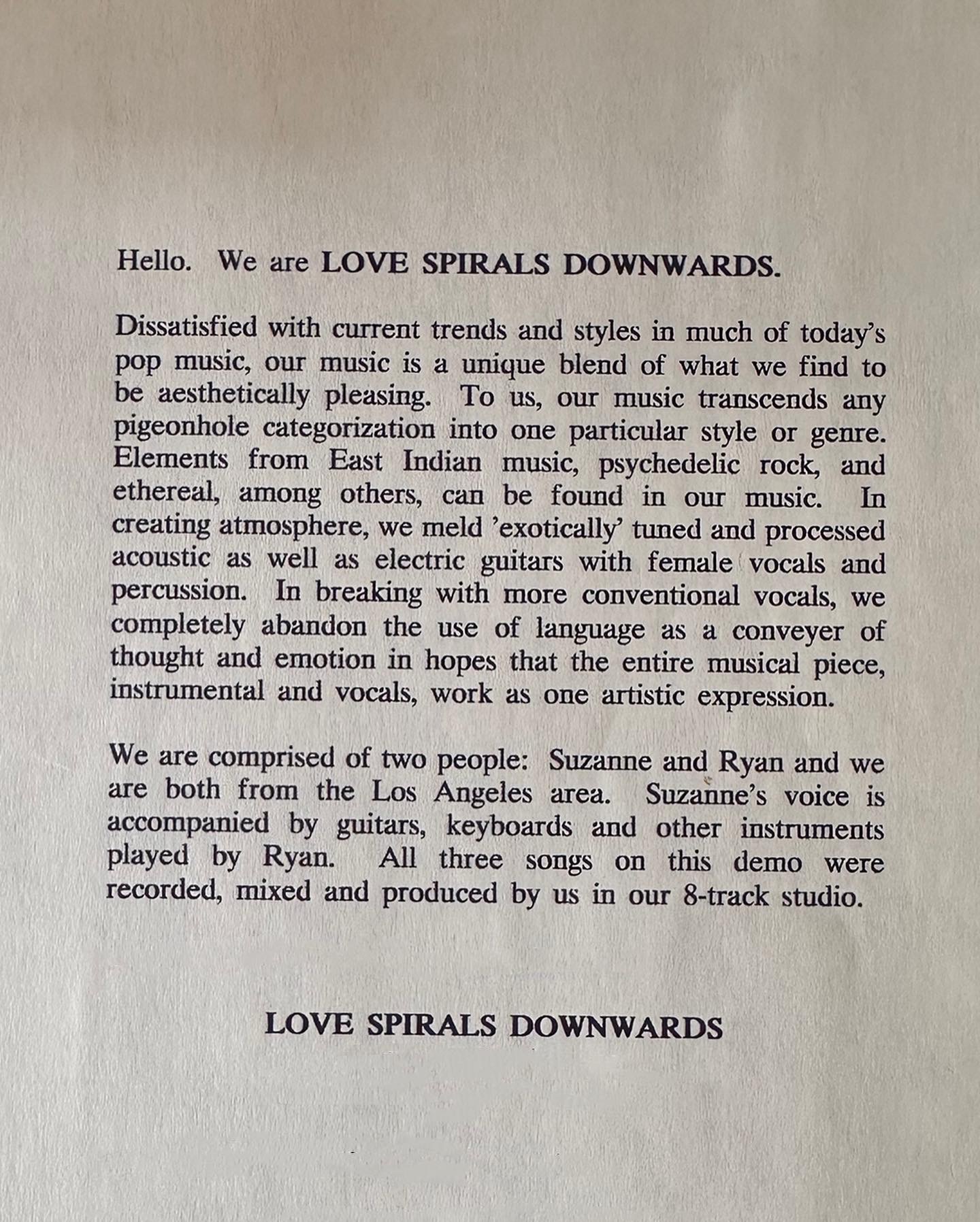
This “un-bandlike” identity was not merely a social quirk; it also shaped their working method and, in turn, their aesthetic. Before the music had reached listeners beyond their immediate circle, Love Spirals Downwards codified this philosophy in a letter accompanying their 1991 three-song cassette demo containing “Mediterranea,” “Forgo,” and “Dead Language.” The text read less as commercial pitch and more like a manifesto, capturing a formative moment where college-era intellectual interests—especially Lum’s studies in the philosophy of language—were beginning to cohere into a distinct musical blueprint:
“Dissatisfied with current trends and styles in much of today’s pop music, our music is a unique blend of what we find to be aesthetically pleasing. To us, our music transcends any pigeonhole categorization into one particular style or genre.
Elements from East Indian music, psychedelic rock, and ethereal, among others, can be found in our music. In creating atmosphere, we meld ‘exotically’ tuned and processed acoustic as well as electric guitars with female vocals and percussion. In breaking with more conventional vocals, we completely abandon the use of language as a conveyer of thought and emotion in hopes that the entire musical piece, instrumental and vocals, work as one artistic expression.
We are comprised of two people: Suzanne and Ryan and we are both from the Los Angeles area. Suzanne’s voice is accompanied by guitars, keyboards and other instruments played by Ryan. All three songs on this demo were recorded, mixed and produced by us in our 8-track studio.”
These claims were not merely lofty ideals; they served as a direct blueprint for the three tracks included on the tape. Each song functioned as a distinct proof of concept for their departure from pop convention.
First, the promise to transcend genre through an atmospheric blend was fulfilled by “Mediterranea.” In Fond Affexxions (1993), Perry described the process almost playfully: “We said, ‘That kind of sounds like an Italian song, a Mediterranean song.’ I just thought I’d use words that kind of sound Italian.” Some phrases were real words, while others only felt Italian to the ear:
The result was less narrative than atmosphere, a vocabulary of mood rather than meaning.
Second, the goal of melding “exotic” elements with percussion was realized in the rhythmic improvisation of “Forgo.” If “Mediterranea” introduced the band’s atmosphere, “Forgo” introduced its origin story as well: the first song they had made together, now heard publicly for the first time. Its tribal percussion, chiming guitars, and glossolalia-adjacent vocal textures made audible the ideas already laid out in the demo letter — the abandonment of conventional lyric meaning which allowed the vocal line to inhabit the song’s structure rather than sit on top of it:
Des cree day hay hay hay / Son coh lay hay hay hay…
Finally, their most radical claim—the total abandonment of language to achieve “one artistic expression”—found its clearest realization in “Dead Language.” In this track, the duo reached toward the sacred. By utilizing phonetics that mirrored Sanskrit devotional names, Perry moved beyond mere vocalizing into a use of the voice that felt more like an invocation. The voice was no longer communicating a thought; it was expressing an essence:
Kala yey ra na / Sa ah hey su ra Ra ja ni ra mo ma han / An la ji ka ra jum na
Through this triad of tracks, Love Spirals Downwards proved that their insular studio process was capable of producing music where the boundary between the human voice and the instrumental landscape simply ceased to exist.
Yet, this artistic revolution was fundamentally underpinned by the declaration’s final line: “All three songs on this demo were recorded, mixed and produced by us in our 8-track studio.”
In the late 1980s and early 1990s, this was a fairly radical stance. At a time when most acts relied on professional outside facilities, engineers, and producers to translate their ideas into finished recordings, Love Spirals Downwards bypassed the traditional gatekeepers entirely. Lum didn’t just have a vision; he possessed the technical infrastructure to execute it, reclaiming the entire process—from the first guitar strum to the final mix—as a single, unified act of creation.
Naming the Non-Band
That same provisional logic extended to the project’s identity itself. Before the demo could be mailed out, the tapes needed a name. When questioned on the meaning behind the name in Black Moon (1996), Lum admitted, “It wasn’t really anything. We had to pick a band name because when we sent out the demo tapes we needed a name. We were pressed to come up with a name quickly.”
Perry pulled back the curtain on how absurd the idea of naming their un-bandlike collaboration felt: “We didn’t have one and we were trying to figure out what to call ourselves. The whole idea of a band was a joke to us. In L.A., but probably everywhere, you meet people and they’re all in a band. So we thought it was stupid.”
Their cynical placeholder names directly reflected that anti-band attitude: “The Flower People,” lifted from This Is Spinal Tap, and the intentionally ridiculous “Peter Pancreous.”
The final moniker emerged from a late-night Southern California radio broadcast. In that same Black Moon interview Perry and Lum described the moment this way:
Suzanne Perry: We were listening to the radio one night late to a new age show and the woman was saying “love, it spirals, upwards, upwards!”
Ryan Lum: It stuck in Suzanne’s head because it was really late… 3 or 4 in the morning. We were parked in front of her house. It tripped us out a lot. So we said, “OK, that’s the band name, Love Spirals Upwards.” Then we decided to change it to downwards.
Suzanne Perry: A friend really suggested the change. He thought it fit better. There’s something cheesy about love spirals upward, you know?
Their initial Altered Mind interview shows the same logic already in place in 1992. Asked about the acronym, Perry admitted, “Originally, it was Love Spirals Upwards,” Lum added that “Downwards had a nicer ring to it,” and Perry noted that “LSU was like Louisiana State University or something.” Lum concluded, “LSD is cooler than LSU.” In As If (1993), Perry argued that the altered name “fit the genre better. It fit our music better, and also there was that acronym, which was kind of interesting.”
The name existed because the demo needed one, and it only settled into its permanent form because they felt it needed something a little darker, stranger, and less “cheesy,” as Perry quipped in Black Moon (1996). In that sense, the band name followed the same logic as the recordings themselves: improvised, practical, and only half-serious until the project began to move beyond their immediate circle.
Looking back on the scramble to name it, Lum later joked in a 1997 KUCI radio interview, “We should have just sent it out as Ryan and Suzanne.”
The Demo Under Deadline
Their decision to create and send out a demo emerged in much the same improvised spirit. In Tear Down the Sky (1993), Perry explained that the two were approaching the end of summer and had set themselves a deadline: “We were coming to the end of the summer, and we had set a deadline. We did three songs and sent them to three places and figured if no one called us on it, we’d just keep making music.”
The urge to send it out was almost accidental. In that same Tear Down the Skyinterview Lum mused, “Why did we even send it out? I guess I was recording another band here who were making a tape to send out to places. So we figured, ‘Hey, we can do that!'” Unsure where to send it, they mailed the three completed songs to three destinations. Lum remembered one of them as Ivo of 4AD, and another as Creation Records, which they knew only of from the back of a Slowdive EP.
The third tape went to Projekt Records.
Like much of Love Spirals Downwards’ early history, the path to Projekt happened without a master plan. The label entered their orbit through Tom Pathe — the visual artist who would later contribute the images used for the covers of Idylls and Ardor — who had attended art school with Susan Jennings, Sam Rosenthal’s photographer for many Projekt releases and the photographer responsible for many of Love Spirals Downwards’ early band portraits.
As Lum recalled in Carpe Noctem (1995), “We didn’t know anything about Projekt” until that connection opened the door. Once they heard the label’s sound, the fit seemed clear: “We got to hear the [Projekt] sound and we thought it was compatible with what we do.” Lum had also read that it was “a really gloomy Gothic label” and had initially been unsure whether they would fit, but as he told As If (1993), it ultimately felt “far better than 4AD” in terms of matching their aesthetic.
In Tear Down the Sky (1993), Perry said, “So we sent them out and forgot about it.” When Sam responded, it was with encouragement rather than a contract. In Carpe Noctem, Lum recalled, “He responded by writing us a nice letter back giving us his impressions of the 3-song demo. He sent us a Black Tape for a Blue Girl CD, which was good because we didn’t know anything about Projekt.” “Sam didn’t say we were signed,” Perry confirmed to Tear Down the Sky. “He said to send more stuff.”
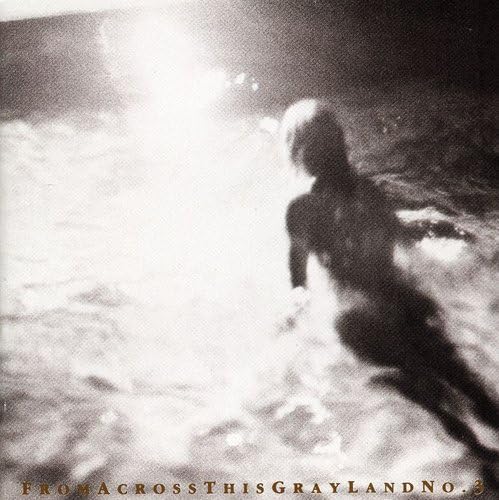
A couple of months later, they sent two more songs, and Sam offered them the first two slots on From Across This Gray Land No. 3. Lum described that placement as their “debut to the musical world” in a 1995 interview with The Big O—the first time their home-recorded work reached listeners beyond their immediate circle. After submitting one or two more songs Sam “ended up asking us if we would like our own record,” as he recalled in Carpe Noctem (1995). Behind the scenes, however, it was Susan Jennings who had truly moved things forward. Perry admitted, “We later learned that it was Susan who originally liked our music. It was Susan who, I guess, really found it and said, ‘OK, listen to this!'” Lum noted that Sam “liked it but was fearful that we sounded too much like the Cocteau Twins,” adding, “but Susan convinced him otherwise.”
In Noising Therapy (Winter 1992/93), Lum clarified, “One of Sam’s requirements for the From Across This Gray Land No. 3 compilation was that we use an unreleased song. We chose ‘Mediterranea.'” The label ultimately selected “Mediterranea” and “Forgo” from the original three-track demo for inclusion. At the time, the Gray Land series served as Projekt’s discovery ground, designed to introduce new talent through music that was “introspective, quiet, and gently swathed in a dewy mist,” as B-SIDE described it in their contemporaneous review. For Love Spirals Downwards, this placement was significant. As The Ninth Wave (1995) later recalled, the experience of hearing the album’s opener—“a lush combination of dreamy, swirling guitar and blissful vocals”—was what instantly hooked listeners. It wasn’t just the sound, however, but the direction they were taking it; as Lum told Altered Mind (1993), their music offered an “uplifting” and “escapist” departure from the more depressing sound of the traditional gothic scene.
But as their music began to find its audience, the duo’s personal lives were moving in different directions. Once the new academic term began, their focus shifted from the studio to the classroom. “We were living an hour apart at the time,” Lum recalled in Tear Down the Sky(1993), “and I wanted us to write him [Sam Rosenthal] a letter together. But that didn’t happen.” Between Perry’s master’s program in psychology and Lum’s deep dive into the philosophy of language, their busy academic schedules left little time for much else. When Rosenthal’s album offer finally arrived, it took them several weeks to respond. Concerned they hadn’t received his letter, Sam wrote again: “You must not have gotten my letter because most people would have answered by now. Are you not interested?” As Perry put it, “We’re really not flaky.” Lum concluded, “we got the second letter from Sam and luckily no bad feelings developed.”
Even as early as their first interview with Altered Mindin September 1992, they were already distancing the forthcoming album from those two early compilation tracks. Asked what listeners should expect from the record, Lum said, “We’re mixing it right now. We just mixed the first three of the eleven or twelve songs. It will have a different feel than ‘Mediterranea’ and ‘Forgo.’ It’s more… what do you think? Trancy, Eastern?” Perry added that they had been “a little reluctant” to place those two songs on the compilation at all, since they were “two of the three first songs that we ever sent him.” She said they were “a little old,” and noted that the album would sound “more trancy, more Indian or Middle Eastern sounding.” Lum put it even more plainly: “More airy and spirally and trancy. The two Gray Land 3 songs are more our old gothic sound.” Even before Idylls appeared, Love Spirals Downwards were already describing their first public tracks as an earlier phase — a first glimpse, not the final shape.