
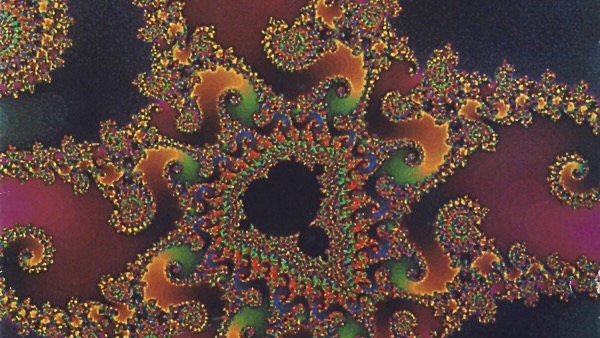
Positioned between Idylls and Ardor, “Kykeon” occupies a quietly pivotal place in the early history of Love Spirals Downwards. Its appearance on the Silent Records compilation 50 Years of Sunshine—a tribute to the discovery of LSD—unintentionally aligned the band’s initials (L.S.D.) with a global psychedelic anniversary. The song’s title itself, referring to the ritual psychoactive drink of ancient Greece, added a layer of historical resonance that mirrored this modern psychedelic context.
Yet “Kykeon” also points inward, toward authorship and continuity. The song reveals how fully formed Ryan Lum’s compositional voice already was by 1991, and the surviving Kristen Perry demo offers an archival alternate-path glimpse of how the project could have sounded with a different vocalist occupying the same sonic architecture.
Its evolution across demo, compilation, and album versions documents refinement of an established sound, while public narratives supplied additional meaning through context.
Early Versions and Structural Development
Stripped of its psychedelic associations and media framing, “Kykeon” begins as a much simpler studio artifact. Its first form was recorded by Ryan Lum with Suzanne’s sister, Kristen, long before the band’s identity had become a matter of public speculation.
The surviving demo—running approximately 4:04—introduces layered “ah ah ah” vocalizations within the first ten seconds. Here, Kristen’s voice functions immediately as atmosphere, woven into Lum’s reverb-drenched guitar lattice. The harmonic pacing, suspended tonal center, and spatial production techniques are already fully realized; in this sense, the demo documents the birth of what Requiem (1996) called the “LSD sound.”
Clip of the original 1990 demo with vocalist/lyricist Kristen Perry
Perry later recalled hearing these recordings while studying abroad. In Altered Mind (1992), she remembered: “I was in London at the time going to school, and he was sending me tapes with my sister on it. I thought, ‘I can sing that. In fact, I can sing that better!’”
An exchange in As If (1993) clarifies the timeline:
Ryan Lum: We started singing together in January of 1991.
Suzanne Perry: My sister was singing with Ryan, maybe like one or two songs… I was going to school in London for a while and hearing tapes of my sister’s… I came back, and basically a little bit after that, we started singing — I started singing on his music.
Perry summarized the early demo period succinctly: “We did two songs together; we scrapped two and kept one, then we did two more, which gave us three songs. We sent them out to Sam of Projekt and that was it. That’s how it started.”
Notably, “Kykeon” was not part of that original three-song demo sent to Projekt Records, nor did it appear on the 1992 debut Idylls, but later entered public circulation through a compilation placement and flexi-disc 7″..
At some point after Suzanne joined Lum, the song was revisited with new vocals. While she retained Kristen’s closing phrase nearly note for note, she reshaped the main melody and lyrics. This placed a new voice at the foreground without disrupting the harmonic language or spatial pacing established in Lum’s original recording.
Public Emergence: Compilation Context and Framing (1993)
“Kykeon” first appeared publicly in 1993 in two formats. The first was 50 Years of Sunshine, released by Silent Records to commemorate the fiftieth anniversary of LSD’s discovery by Albert Hofmann. The second was a limited-edition 8-inch clear flexi-disc included with Altered Mind #14 (August 1993) — an evocative zine name that further reinforced the psychedelic associations being built around the band. Limited to 1,000 copies and also featuring a previously unreleased track by HALO, the sound sheet became a sought-after artifact within the ethereal and Projekt-adjacent scene.
The song’s emergence followed a unique trajectory that placed it outside the standard album cycle. In fact, Altered Mind captured this transitional moment by categorizing “Kykeon” as an anomaly, describing it as:
“A remix of a rare song… To date, the band’s recorded output comprises the album, the two Gray Land 3 tracks, and a song on the Silent Records compilation 50 Years of Sunshine.”
“Kykeon” remix from the 50 Years of Sunshine compilation (1993)
The title itself added another layer of resonance. In ancient Greece, kykeon was the ritual drink associated with the Eleusinian Mysteries, and modern scholars have sometimes speculated about its psychoactive properties. Whether or not that association mattered to the band in any deliberate way, it sat suggestively beside the song’s appearance in a 1993 milieu shaped by 50 Years of Sunshine and a music press newly attentive to LSD-related imagery and themes.
Yet musically, the track’s inclusion on 50 Years of Sunshine represented something more practical than symbolic. As Lum noted at the time, the version would be remixed for the forthcoming album. In that sense, the compilation did not mark the culmination of the song’s development, but an intermediate stage — a public preview of material still in transition.“Kykeon” would appear once more in revised form — this time within the context of the band’s second album.
Refinement on Ardor (1994)
When Ardor was released in 1994, “Kykeon” reappeared in yet another iteration. The album version runs 4:45, slightly shorter than the 4:51 mix issued on 50 Years of Sunshine, and markedly longer than the 4:04 Kristen Perry demo. Lum had indicated in Fond Affexxions (1993) that the compilation version would be remixed for the upcoming album. When asked the following year about the differences, he clarified: “It’s not the same version, but it’s roughly the same thing.” That phrasing is telling. “Kykeon” on Ardor is less a reinvention than a refinement.
“Kykeon” from the 1994 Love Spirals Downward album, Ardor
Structurally, the song retains its core architecture: suspended harmonic progression, layered clean guitars treated with delay and reverb, and a gradual intensification toward a closing vocal coda. The most striking difference lies in pacing. In the Kristen demo, vocals enter almost immediately — within ten seconds — functioning as textural atmosphere. In contrast, both the 50 Years of Sunshine mix and the Ardor version withhold vocals until deep into the track: approximately 3:05 on the compilation mix and 3:02 on Ardor.
This delayed entry reshapes the listening experience. Rather than voice guiding the piece from the outset, Lum’s instrumental lattice establishes a three-minute environment before Suzanne’s lyrics appear. The atmosphere is no longer framed by vocal abstraction; it is constructed instrumentally first.
Lyrically, Suzanne’s version differs significantly from the Kristen demo. The earlier refrain — “she walks into sheltered walls” — disappears. In its place are lines adapted from Kahlil Gibran’s “On Crime and Punishment,” drawn from The Prophet (1923):
“Unbidden shall it call in the night
And gaze, upon themself
Your needs, my love…”
The shift from impressionistic repetition to literary adaptation introduces a new layer of thematic gravity. Yet even as the lyrical content changes, the song’s emotional temperature remains consistent: hushed, interior, suspended between melancholy and transcendence.
Perhaps most revealing is the ending. The closing “ah ah ahh” vocal motif — present in the Kristen demo — is preserved in Suzanne’s recording nearly note for note. It functions as a subtle bridge between incarnations, a sonic continuity that survives vocal succession.
If anything, the Ardor version clarifies what had already been there. The harmonic language, the sense of atmospheric drift, the patient build — these are Lum’s signatures from the beginning. Suzanne’s entry does not alter the architecture; it reframes it with a more defined lyrical voice and expanded expressive control. In this sense, “Kykeon” across its demo, compilation, and album forms illustrates evolution without rupture. The sound was established early. What changed was emphasis, pacing, and public context.
50 Years of Sunshine, Option, and the LSD Association
The inclusion of “Kykeon” on 50 Years of Sunshine sharpened an ambiguity that had existed around Love Spirals Downwards’ initials from the beginning. Ryan Lum and Suzanne Perry never denied that the acronym was there, but they consistently resisted the idea that it carried any fixed ideological meaning. In Altered Mind (1992), Perry recalled that the project had originally been called “Love Spirals Upwards,” while Lum said that “Downwards” had “a nicer ring to it” and gave the name “a more gothic twist.” Perry added that they had noticed the initials because “LSU was like Louisiana State University or something,” and Lum concluded more bluntly: “LSD is cooler than LSU.”
That latent ambiguity, however, soon become part of the band’s public framing. In As If (1993), Lum insisted that “there’s no meaning behind it. It’s not supposed to refer to anything; it’s not supposed to mean anything,” while Perry added that it was “not really related to LSD or anything.” At the same time, Lum acknowledged that the coincidence had “kind of helped us, in a way,” citing the band’s inclusion on Silent Records’ 50 Years of Sunshine, “a tribute to Albert Hofmann’s first accidental ingestion of LSD.” Perry noted in the same interview that Option magazine was also preparing “something LSD-related” so they had “asked us some things about our name,” and Lum summed up the feature topic as “LSD and music, some kind of revival.”
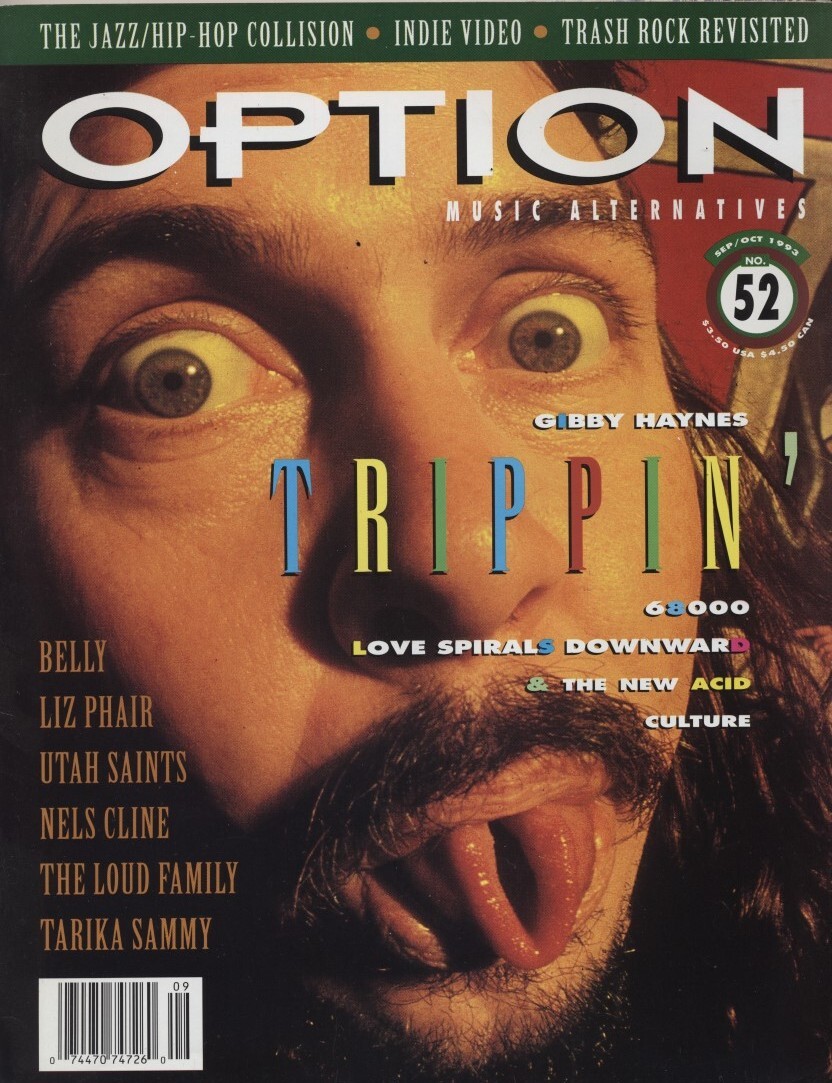
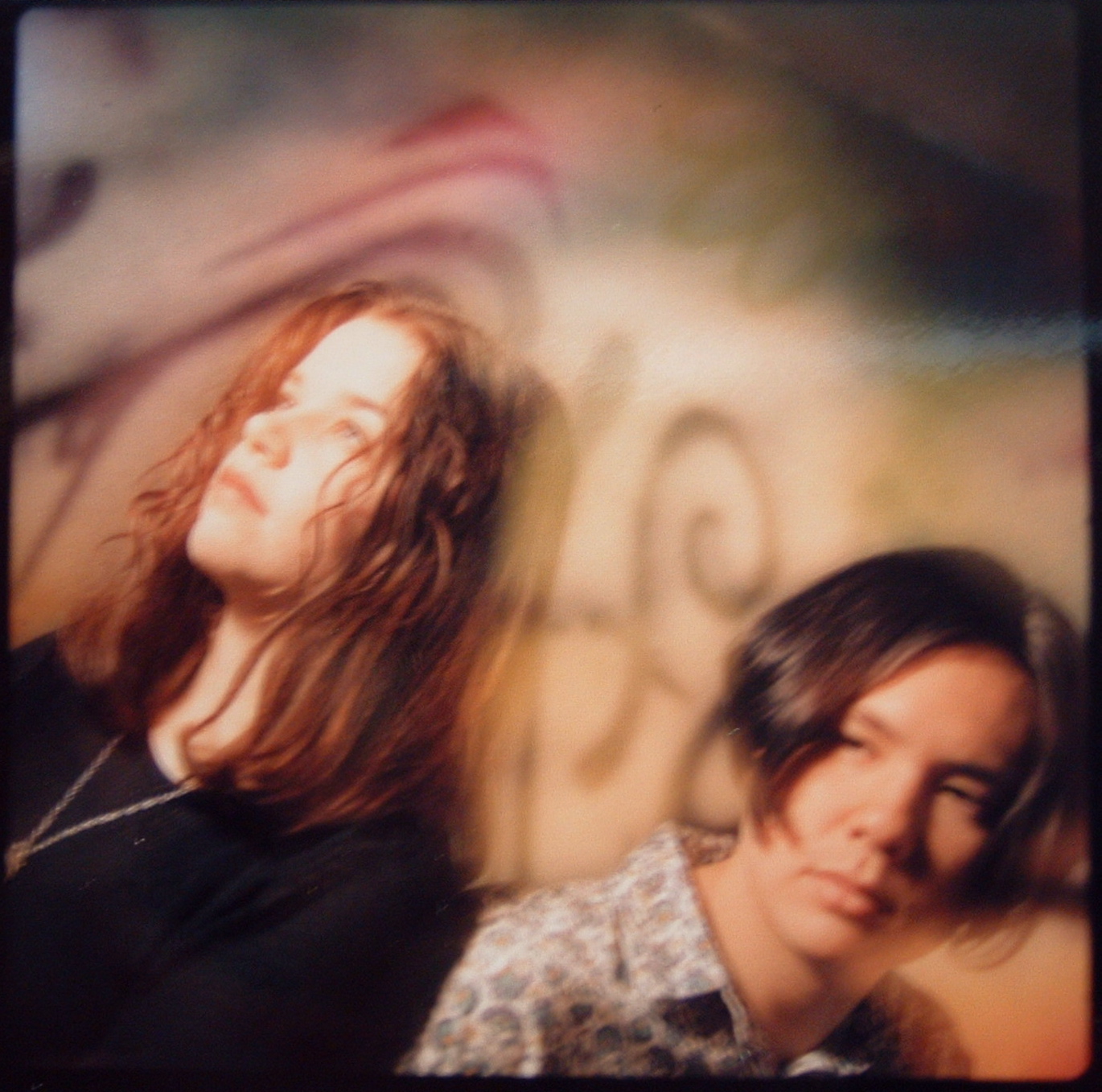
Their appearance in Option No. 52 (Sept./Oct. 1993) deserves particular attention because it did more than simply ask about the initials of the band’s name: it inserted Love Spirals Downwards into a larger editorial construction of contemporary acid culture. The issue’s cover, featuring Gibby Haynes of the Butthole Surfers, announced: “Gabby Haynes: Trippin’ 68000, Love Spirals Downward & The New Acid Culture.” That framing was indirectly linked to the broader commemoration of the year marking the fiftieth anniversary of Albert Hofmann’s discovery of LSD’s psychoactive effects. The feature reinforced the theme visually as well, with photographer Laura Crosta portraying Lum and Perry in front of a wall marked by neon swirls.
Read in that context, the band’s later frustration with the interview becomes easier to understand. Lum told Fond Affexxions (1993) that Option had been “trying to get a definite angle on that story; get us to come out and say how we’re big druggies,” while Perry put it more sharply: “They were putting drugs in our mouths.”
The clearest account of how the 50 Years of Sunshine compilation placement came about appears on the official Projekt Ardor Interview cassette from 1994. Perry explained to interviewer Jon Gonzalez that the invitation had not come directly from Silent Records to the band, but through Projekt: Kim Cascone “asked Projekt if there’s anyone on your label that would be interested in doing this, and I think that Sam and Kim talked about Love Spirals Downwards, and the LSD acronym, and he asked us and we said, ‘Yeah, we’ll do it.’” Lum, meanwhile, described “Kykeon” as “one of our new songs, a first glimpse of what we sounded like after Idylls.” That pairing of statements is revealing. The compilation belonged to the same fiftieth-anniversary moment and assembled an eclectic cast that included spoken word by psychedelic icon Timothy Leary along with experimental artists such as Nurse With Wound, Psychic TV, Controlled Bleeding, and Hawkwind. In that setting, Love Spirals Downwards’ contribution could easily be read as part of a curated psychedelic-historical frame, whether or not the band intended it that way.
The confusion could even become literal. In that same interview with Jon Gonzalez, Lum recalled that “one person from Paris” had written to the band after seeing the address printed in the 50 Years of Sunshine liner notes, apparently asking them to send acid. Perry said she used a dictionary to decode the French missive: “I think that they were —in code, in French— asking us, ‘send us some tabs!‘ Or something.” Lum then pointed to the likely source of the misunderstanding: “Inside the 50 Years of Sunshine compilation, there’s a listing for Love Spirals Downwards that says ‘LSD Contact Address.’” He added: “Someone who doesn’t know their English that well might mistake that as ‘write to these people.’ But they knew we were the band, too, so I don’t know. I’m completely baffled to this day about that.”
Beyond the Acronym: Navigating Identity and Association
Lum and Perry did not always manage the subject in the same register. InTear Down the Sky (1993), after Lum remarked that 50 Years of Sunshine commemorated “a momentous point in history” and added that “I don’t think things would be as they are now if it wasn’t for that,” Perry interrupted: “That’s your opinion. Anyway, some people get on our case about it, so we kind of get defensive.” Lum then tried to neutralize the matter: “We aren’t anti or pro drug… We make music. We aren’t politicians.” A similar moment occurs in Fond Affexxions (1993), when Lum began commenting on LSD as a “go-nowhere psychedelic” without “the shamanistic component the others do,” only for Perry to shut the exchange down: “He’s already talked too much about it.” While these exchanges don’t suggest a major internal dispute, but do show Perry attempting to prevent drug-adjacent commentary and speculation from defining their public image.
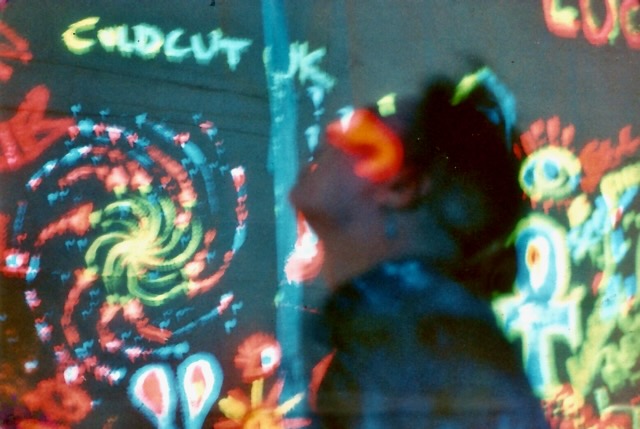
That caution is especially interesting because Lum’s other interviews make clear that psychedelic-adjacent club culture was not foreign to him personally. He told Fond Affexxions (1993): “I’ve been to some Grateful Dead shows. I’ll go to raves… at least they used to be called raves. I don’t go anymore.” In Isolation (1993), he described leaving the stagnant Los Angeles gothic scene around 1989 for the then-new acid house clubs, recalling “Alice’s House” as a place of “colorful psychedelic lights, blacklight/day-glo rooms, and hypnotic trance inducing music,” and he spoke positively of The Orb because their music produced “a strong hypnotic state” in him. Later sources preserve the same thread: in Fix (1998) writer/DJ Daniel Bremmer referred to Lum’s interest in the late-1980s and 1990s rave scene, then in a later 1998 KUCI broadcast Bremmer jokingly called him “the big rave kid.” In a 2000 KUCI appearance Lum said that “for the whole decade of the nineties” he had been going to electronic and techno clubs and was accustomed to “house, trance, all that,” even if it was “not my fave.”
Later interviews preserve much the same qualified position. In Requiem(1996), the matter was raised directly:
Requiem: LSD is the acronym for Love Spirals Downwards. Do you have a lot of people asking you about that reference? Does it ever get tiring?
Ryan Lum: No, I think it’s interesting. There are a lot of bands whose names I wonder about; I ask people that too, so no, I don’t get tired of it. The whole drug connection to our name, I don’t know what to think. We were aware of it when we made the name, but we didn’t want it to be an endorsement for the drug.
The exchange is useful because it states the issue with unusual clarity. Lum neither disowned the acronym nor embraced the interpretation built around it. Instead, he treated the question as understandable, even interesting, while still drawing a line at endorsement.
Rather than a hidden confession, the recorded history reveals an unstable intersection. The band was aware of their initials, yet they resisted allowing external framing to dictate their meaning. “Kykeon” entered the world exactly at this point of friction: between aesthetic ambiguity, editorial pressure, and a public eager to treat resonance as declaration.
Continuity in Transition
Across its 4:04 demo with Kristen Perry, its 4:51 compilation mix, and its 4:45 Ardor incarnation, “Kykeon” traces the refinement of a sound already present in Ryan Lum’s earliest studio work. While its harmonic language, spatial pacing, and atmosphere remain largely consistent, changes in lyric, vocal phrasing, and mix emphasis produce distinct listening experiences within the same underlying structure.
What changed across the song’s versions was not its underlying architecture, but the framing brought to it over time. “Kykeon” moved from private demo to compilation appearance to album track without losing its essential identity. Heard across those iterations, the song documents continuity under revision: one musical vocabulary, several realizations, and a project already capable of surviving internal change while remaining recognizably itself.
NEXT CHAPTER: Ardor: Distance, Refinement, and the Peak of their Projekt Sound