
Ever (1996), the third album by Love Spirals Downwards, marks the point where the duo’s ethereal intimacy began opening toward the electronic soundscapes that would define their next chapter. Balancing ambient textures, folk-inflected guitar, and emerging electronica elements, the album occupies a distinct middle ground — described by the All Music Guide as a record where the band “finds a good balance between a more acoustic sound and modern electronica.” Amazon Editorial reviewer Steve Landau praised it as “a languid, atmospheric, but unfussy affair,” blending Perry’s airy vocals with Lum’s echoing electric and calming acoustic guitars.
Released on September 15, 1996 by Projekt Records on CD —no cassette, and no European license to Hyperium as its predecessors had carried— Ever was a more modest commercial proposition than Idylls or Ardor, selling approximately 10,000 copies against the 15,000 each of the earlier albums had reached. Projekt’s own promotional copy framed it in terms of range rather than limitation:
“Ever is the duo’s most musically diverse to date, spanning a space between simple, flowing acoustic guitar and vocal melodies to euphoric, looping atmospheric ambience. Ever is a unification of vocal, guitar, and electronic elements, distilled to the essence which remains Love Spirals Downwards’ unique, sumptuous sound.”
“Who Knows If There Will Be a Third Album?”
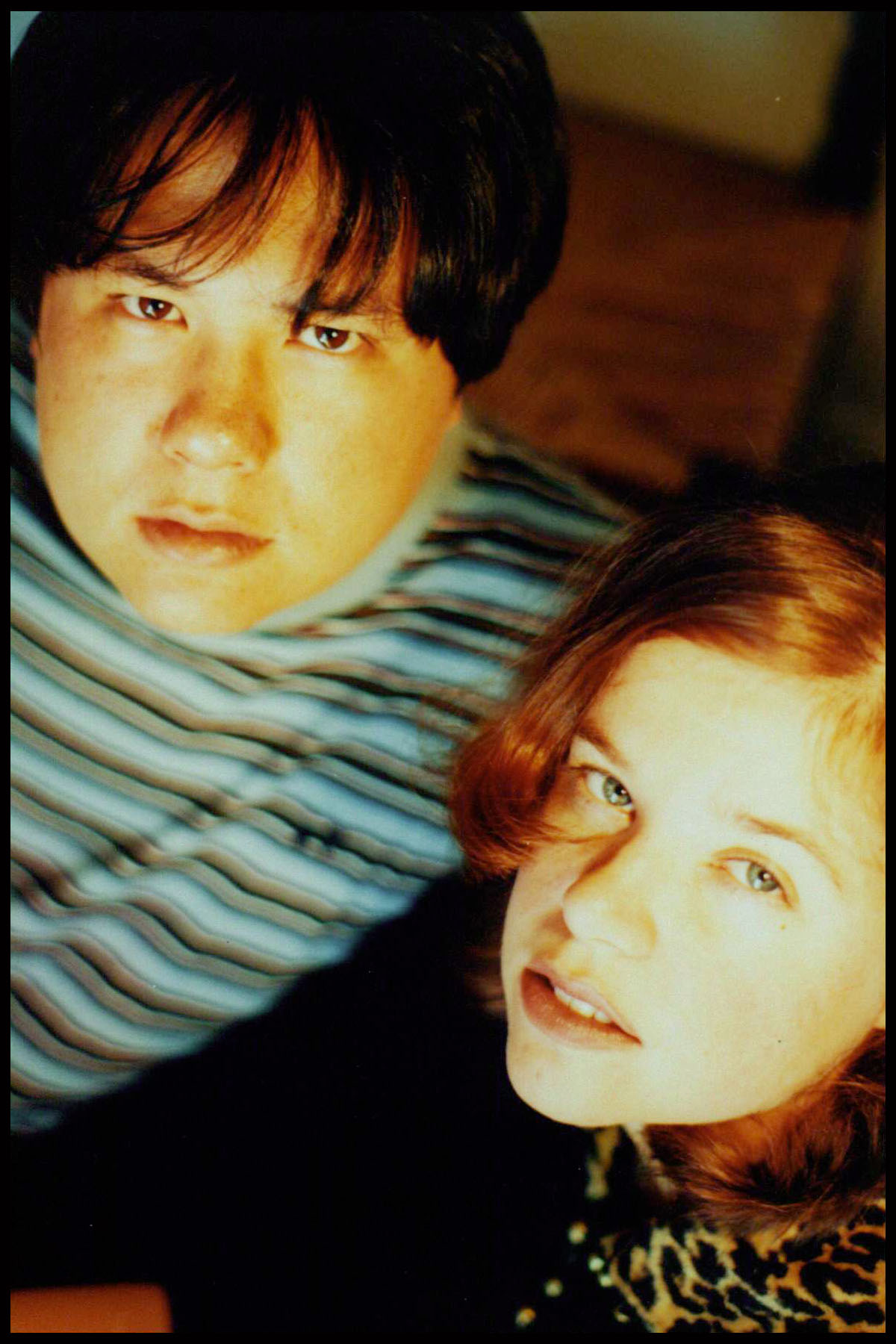
Ever nearly didn’t happen at all. The band had just finished Ardor after a year and a half of work — and when Danse Macabre interviewer Davyd asked whether they planned to continue, Perry’s first response was an exhausted “Oh God!!” When he pressed further — asking whether the band was something she wanted to pursue indefinitely alongside her studies — Perry hedged carefully at first: “We definitely do other things. That’s just how I am, I sort of balance everything out.” But the hedge gave way to a harder limit: “I don’t think I could just sit and do only music, it wouldn’t be enough.”
Lum pushed back — at this point, Love Spirals Downwards were not yet doing live performances, so Perry’s responsibilities to the studio project were minimal: “Well, it would be impractical too. I don’t think your singing takes up that much time. But the stuff I work on could be a full time job” — but Perry named the deeper tension: “Ryan’s been talking about not going to graduate school. I’m not ready to just quit and do music now — I wouldn’t quit Psychology.” Lum followed the thread to its uncomfortable end: “So who knows if there will be a third album? I don’t know.“
Perry was more pragmatic: “I think so — it depends on how well this one is received.” Lum was characteristically unconcerned with that calculus: “Even if it’s not, I don’t care. I know what I want to start making now. Especially after we recorded the last half of the album, I kind of see the structure I’m heading towards” — a direction telegraphed by Ardor‘s closing tracks, particularly the beatless, guitar-free “Sunset Bell,” built entirely from looping vocal textures by guest vocalist, Jennifer Wilde. When pressed to elaborate further, he stayed deliberately vague. Perry, having none of it, cut straight to the point: “You want it to sound like Slowdive.“
She wasn’t wrong.
Musical Inspirations and Technical Innovations
Ever finds the Love Spirals Downwards blending acoustic folk textures with ambient electronic grooves in ways that pushed the boundaries of their earlier sound. This shift was shaped not only by Ryan Lum’s changing musical inspirations but also by his growing expertise with innovative recording techniques and equipment, such as samplers, which deeply influenced his songwriting process.
Reflecting on the finished album in Acoustic Guitar (1997), he noted: “One thing I like about our new album is that it’s almost impossible to categorize it with any of the conventional musical categories. There are really folky songs, really electronic ambient dance songs, and then these weird, loopy psychedelic songs. I think it all works together really well.” That resistance to categorization was no accident — it was a guiding principle. Even before Ever was recorded, Lum had been clear about who he was writing for: “I write what’s going to please me, not somebody else, not the record label, or some unknown hypothetical band somewhere.”
The looser, exploratory structure of Ever was partially inspired by contemporaries like Seefeel, Slowdive, and Perfume Tree, whose seamless blending of organic and electronic sounds resonated with Lum’s creative vision. Slowdive, in particular, was an enduring influence; their transition from dream pop to more experimental soundscapes validated Lum’s desire to step beyond the confines of genre.
In a 1996 Daily Freeman interview, Lum described how his songwriting process often began in the studio: “We’ve got our own home recording studio. We’ve had it for years and have just been growing and expanding it. In fact, the way we write, we have to do it at home. I’ll have some rough sounds or ideas and I’ll record them down on tape or into the sampler, and from there I’ll start getting more ideas. It will build from what I previously recorded.”
This willingness to experiment extended to the live setting as well, as Lum revealed in a 1997 KUCI radio interview with Ned Raggett: “I have been thinking about fusion of influences, doing half of our set all acoustic and the other half bringing more electronic stuff out, samplers, and seeing how that goes. More groovy, dancey stuff along with our acoustic folk.”
That acoustic foundation — clarified through live performance and then expanded in the studio — found its emotional counterpart in Suzanne Perry’s lyrics, which wove together themes of time, memory, and impermanence across the album’s vocal-focused tracks. Yet, for all these recurring themes, the way these words were presented was governed by a philosophy that defied traditional songwriting.
Distillation of Sound: Sideways Forest Single
The acoustic/electronic duality Lum had been developing in the studio found its first public expression not on the album itself, but in a single released a month before it. Unlike their first two albums, which arrived without any singles, Ever was preceded by the duo’s first ever maxi-CD single — an experiment by Projekt that proved to be a fitting preview of the album’s range. The release tied the transformation directly to the band’s foray into live performances:
“Triggered by the group’s experiences playing live with a more stripped down, acoustic set, on “Sideways Forest” we hear the intrinsic beauty of simple, flowing guitar melody and a lone, singular voice, beckoning listeners to embellish the sound in their own minds. The “Quantum Remix” deconstructs these acoustic elements and rebuilds from the song’s foundation, adding sampled and electronic patterns, morphing them into a euphoric journey into trip-ambience. The disc concludes with the instrumental “Amarillo,” echoing themes hinted at on “Sideways Forest,” while uniting the group’s acoustic elements and flowing, open atmospherics.”
Notably, Lum’s editorial choices create an unintended irony: by sampling exclusively from the first verse, he omitted both the chorus — which contains the “sideways forest” imagery of the title — and the second verse, which holds the most quantum-resonant lines on the entire track: “Like waves and words / Better not to watch at all / This changes everything,” an almost literal evocation of the observer effect. The result is a remix whose title refers to nothing actually present in it — the “sideways forest” and the quantum philosophy both ghosted into the cut material, while the track itself loops into pure abstraction.
Abstractions aside, the single drew notice well outside the band’s usual audience. Flipside (April 1997) and Under the Volcano (#36, early 1997) — both better known for covering punk and hardcore — responded with genuine enthusiasm. Flipside kept it simple: “If this 3-song EP is any indication, I’d definitely put my money down on a full-length CD by this band. It puts me in mind of This Mortal Coil, but has a soul and a feel all its own.” Under the Volcano‘s reviewer Groovy admitted to being “a sucker plain and simple” for Perry’s voice before zeroing in on the Quantum Remix: “It explores the trance terrain with a light tapping drum and bass rhythm — it’s rather poppy, and I wouldn’t expect it to come out of the Projekt camp,” concluding that it “definitely reveals that Love Spirals Downwards has the potential to be a million dollar band.“
That crossover quality wasn’t lost on the ethereal and dream pop press either. Dewdrops (#16, Spring 1998) — the fanzine founded by Brant Nelson and Pat Mannion that had long championed the genre — weighed in nearly two years later, the timing itself a testament to the fanzine format’s unhurried rhythms. Nelson was characteristically wry about the remix format: “When all is said and done, there will be an ambient remix of every single song ever written. The ‘Quantum Remix’ does this for the preceding track, adding about two minutes in the process. It’s nice and dreamy.” Pat Mannion was more effusive, calling it “more interesting and even more pleasant” with “a gentle electro feel one might call ether-techno-madrigal-lite, but only if one were prone to fits of hyphenated clichê.“
This critical consensus was backed by measurable interest; the Sideways Forest single moved over 2,000 copies, a significant showing that signaled that the audience was willing to follow the band into more experimental, electronic-leaning territory. Lum noted on the band’s website in September 1996 that Projekt reported the “trip-hoppy” Quantum Remix had been “getting a bit more radio and club play than normal” — a small but telling sign that Ever‘s sound was reaching well beyond the band’s established audience. While the Quantum Remix and the ‘poppy’ accessibility of the single expanded the band’s reach into new territories, the full album would further challenge the listener’s perception of the project—not through a planned shift in direction, but through a more fluid, spontaneous approach to songwriting.
“What Is The Meaning of a Sunset?”
Despite the band’s insistence that their songs were devoid of explicit meaning, Ever traces an unmistakable emotional arc—one its creators were careful not to overdetermine. This philosophy often put them at odds with critics seeking deeper subtext. In a 1996 interview with the German fanzine Black, the interviewer expressed disappointment that Lum claimed their material lacked meaning, insisting that music must serve as a means of expression.
Lum’s rebuttal was a cornerstone of the band’s aesthetic: “No, there really is no meaning behind it… It is very difficult to build a meaning without lyrics, which is related to the fact that Suzanne sometimes sings in no real language at all. The music itself naturally has a ‘message’ for me, but this message obviously affects other people differently. It means whatever you want it to mean, if you absolutely need a message. But what is the point of a message anyway?”
This openness to interpretation was rooted in Perry’s own approach to performance. In a 1994 Fond Affexxions interview, she described her deliberate rejection of traditional clarity: “Even if I have lyrics, I don’t stress pronunciation at all. In vocal training, they stress that — to speak clearly, to sound out every word, and make sure you end each word you’re singing. I don’t like that.”
For Lum, the resulting ambiguity was not a flaw, but a feature of the art. Speaking to Dusk Memories in 1994, he recalled an instance where a friend transcribed what she believed were the lyrics to their songs: “And they were different from ours. But the interesting thing is that her lyrics were just different from ours, not better or worse. The way she had transmitted her meaning to the texts was really intriguing.”
This avoidance of heavy-handed meaning was deeply connected to how the duo approached their roles within the project. For Perry, music was often a secondary pursuit to her academic life, and she utilized an instinctive approach to lyricism that prioritized sound over narrative. In a 1997 interview with Ned Raggett on KUCI 88.9 FM, she explained: “The lyrics in my songs have nothing to do with writers or poetry or any of that stuff, except for stuff that subconsciously influences me.” Ryan Lum described this method as a form of spontaneous prose, noting, “She makes words and sounds and uses them to enhance the feeling of the music. Asking her to write a real story or poetry would be almost a foreign concept to her.”
Because Perry treated language as an extension of the music rather than a vehicle for a message, she was able to keep her creative and personal worlds distinct. “I compartmentalize my music,” she explained in that same KUCI interview. “It’s something I do as a hobby and a side thing, and I don’t really mix it with my life. Even my everyday emotions I don’t think I mix with it. But every so often, I think it seeps in. It’s interesting, because it truthfully makes me uncomfortable. In some ways, I think it’s kind of sappy and too expressionist to put your life in your music like that.”
This tension between language and intention is central to the album’s identity. Speaking to Pat Ogl for the 1997 ProjektFest Guide, Ogl noted a significant evolution: instead of “sounds and nonsense,” the band had gradually begun to use lyrics. Lum confirmed this shift, though noted the change was not an attempt to provide clarity: “I recently realized that on Ever, there are no songs that have nonsense words… Though this doesn’t mean that the lyrics necessarily have any meaning. It’s just part of the constant evolution of our music and getting bored of doing the same old thing over again.”
Ultimately, this move toward language was part of an almost ascetic approach to creation—an attempt to achieve a purely experiential result. When asked why he resisted the urge to tell stories or make points, Lum framed the band’s philosophy through a lens of Zen-like acceptance:
“I’ve just never felt that art must have meaning — it just is. It’s sort of a funny fallacy that most people seem to insist upon everything in the world as having meaning. What is the meaning of a sunset? What’s wrong with just simply experiencing it?… Likewise, our art exists without demanding that it has some higher or more important existence apart from the experience of it.”
This sense of discovery extended beyond the writing process and into the recording studio. Just as the lyrics emerged spontaneously—what Ryan Lum described as “spontaneous prose” in their 1997 KUCI interview rather than planned poetry—the album’s sonic landscape was shaped by a parallel spirit of experimentation. The atmospheric depth of Ever wasn’t the result of a rigid blueprint, but rather a series of discoveries made through an intricate signal chain of effects and textures.
The Tools of Texture: The Ever Signal Chain
That vision was realized through a specific, tactile set of tools. Ryan Lum continued to rely on the core equipment that had defined the first two albums—most notably his Tascam 388 8-track reel-to-reel recorder, which provided the warm, analog depth characteristic of their sound. His primary melodic palette was shaped by a Gibson Les Paul electric and an Ovation 6-string acoustic, processed through a Roland DEP-3 and a Boss DC-2 Digital Dimension chorus pedal to achieve that signature shimmering breadth. The addition of an Ensoniq ASR-10 sampler opened up entirely new compositional possibilities: by sampling vocals or guitars and mapping them across the keyboard, Lum could play those audio fragments chromatically, building loops and melodies in real time.
The equipment choices reflect the album’s dual nature. Lum was deliberate about contrast—what AllMusic’s Bryan Reesman described as an album where “dance grooves underlie certain tracks, but folksier tunes surface throughout the record.” Several tracks—“Last Classic,” “Ipomoea,” and “Promises”—are entirely beatless, letting melody and texture carry the weight alone. Where rhythm does appear in subtler forms, it stays organic: “Lieberflüsse” relies on little more than hand drums and an egg shaker, grounding the track without disturbing its delicate atmosphere.
With the conceptual blueprint set and the signal chain established, the result was an album of calculated contrasts—a sequence where each track serves as a distinct window into this evolving sound.
The Architecture of Ever: A Track-by-Track Journey
Upon its release, Ever was recognized as a pivot point for the band—a record that pushed ethereal music into a “deeper realm.” Writing for Industrial Nation (#14), Lisa described it as a “very serene piece of art” where the songs simply swirl together, noting a distinct “4AD touch” while remaining uniquely their own.
Other critics saw the album as an evolution of the genre itself. Stephen Thompson of the AV Club suggested that Love Spirals Downwards were playing “post-shoegazer” music, co-opting the billowy vocals and pretty guitar lines of the era but stripping away the “layers of cloudiness” that typified bands like Slowdive or pre-1995 Lush. In Thompson’s view, Ever played through like “one long, meandering voice,” balancing dramatic vocal swoops with moments of ambient exploration.
This shift toward a more curated, atmospheric sound meant that Suzanne Perry’s crystalline voice was reimagined as part of the instrumentation. The record marked a turn toward abstraction—her vocals looped, layered, reversed, or buried in reverb until they hovered more as atmosphere than message. As Bikini Magazine observed:
“Even the half dozen instrumentals not graced by Perry’s remarkable voice deliver delicate foreboding allure, like mist at dawn’s break. This proves itself to be rather affecting mood music.”
1. “El Pedregal” – Naturalism and Scale
Opening the album, “El Pedregal” blends acoustic guitar with swirling synths, Manchester-inspired drumbeats, and a soaring EBow guitar solo. The title, which translates to “The Rocky Place” in Spanish, evokes a stark, natural setting. Rather than providing a clear narrative, Perry’s lyrics hint at elemental imagery through a delivery that remains intentionally elusive. Whether she is singing “I wait by this cold sea” or “old sea,” and whether the following line is “As time rolling over me” or “tide,” either reading is equally evocative. The presence of the sea, paired with the track’s scale, creates a soundscape that feels both timeless and intimate, capturing a sense of human presence within a vast, indifferent landscape.
2. “Sideways Forest” – The Weight of Forgetting
The single from Ever, “Sideways Forest” grew out of the band’s live performances, where their stripped-down acoustic presentation revealed the song’s spare, unadorned core. Projekt described the single as “a distillation of their sumptuous sound… featuring simple, flowing guitar melodies and a lone, singular voice, beckoning listeners to embellish the sound in their own minds.“
Perry’s lyrics mirror the song’s melancholic arrangement through fragments that suggest transformation:
“This is the time when water stops / History dies with you / Like rings of trees in sideways forest / Forgetting”
Perry’s imagery here carries its own quiet logic; the “rings of trees in sideways forest” evokes dendrochronology—the reading of tree rings as a record of time. It suggests that a felled or fallen tree exposes its entire history at once, only to have those records dissolve into forgetting.
Lum credited the song’s atmosphere in part to his experimentation with alternate tunings, an influence he traced back to Red House Painters and their album Songs For A Blue Guitar, which he listed as one of his top five favorite albums of 1996: “‘Sideways Forest’ is in a weird tuning which I learned from seeing the set list of a Red House Painters show on the Internet. I saw one that looked interesting and I tried it, and that’s how ‘Sideways Forest’ came about.”
The single’s sparse arrangement centers on Perry’s plaintive vocals, while the accompanying “Quantum Remix” pulls the track in the opposite direction entirely — reimagining it as a loop-based electronica piece driven by beats and synths, a duality that encapsulates the band’s ability to inhabit both worlds without contradiction.
3. “Madras” – Ambient Mantra
“Madras” moves deeper into abstraction, building on swirling synthesizers and a repeating loop of Perry’s vocals combined with an ethereal ad lib. The track’s atmospheric manipulation shows clear influence from Seefeel, combining melody and texture into an immersive soundscape. Drawing from the “Depression Glass” recording, Lum bends the sampled phrase, “Promises of love and light,” into a pulsing ambient mantra over six minutes in length. This approach to voice-as-texture earned the track a place on the iTunes Essentials: Shoegaze and Beyond playlist in 2006, alongside genre-defining artists like Cocteau Twins, Slowdive, and Lush, in the Deep Cuts.
4. “Last Classic” – Melancholy and Echoes
“Last Classic” stands as one of the album’s most somber moments. While it maintains the same atmospheric quality as the rest of the record, Perry’s delivery here feels particularly intimate, making the lyrics easier to discern as they dwell on the sensations of memory and its eventual fading: “We won’t want to stay when it’s the same/ I won’t try and say I don’t see it / I won’t care, stay here awhile / There is this hold / Fainter still, lesser ’til it’s gone away“
The song’s minor-key composition and Perry’s mournful delivery capture a sense of wistfulness, as if clinging to the echoes of what once was. Lum’s arrangement, understated yet evocative, enhances this introspective tone, making it a haunting centerpiece of the album.
5. “Ipomoea” – Pastoral Stillness
Clocking in at just 1:03—the shortest track on the album—“Ipomoea” serves as what Ryan Lum described in a 1996 interview with Ned Raggett for Mean Streets as “a little mood piece between the songs.” Featuring only acoustic guitar, the track evokes pastoral stillness and quiet reflection. Named after a plant whose seeds are said to have psychoactive properties akin to LSD, its brevity and organic sound provide a moment of raw, reflective peace that ties into the nature imagery found throughout the record.
6. “Delta” – Aquatic Drift
Continuing the aquatic imagery established in the album’s opening, the river motifs in “Delta” suggest a sense of movement and dissolution against a bright, Americana-infused arrangement: “Stretch, stretching / Far beyond this delta between we / Dive, diving / Deep beneath the surface suddenly.” The aquatic metaphors create a feeling of drifting, while Lum’s backing vocals provide a dynamic interplay reminiscent of Mojave 3’s male-female harmonies. Industrial Nation drew a parallel to His Name is Alive—an apt reference given that band’s similarly blurred boundary between American folk textures and ethereal production. These elements ground “Delta” in a broader conversation with contemporary dream pop; Lum had cited Mojave 3’s Ask Me Tomorrow as a key influence on Ever, even performing their songs alongside Perry in 1996.
7. “Cay at Dawn” – Shimmering Transitions
“Cay at Dawn” conjures a serene, otherworldly atmosphere. The title’s reference to a small, low-lying island surrounded by water reinforces the album’s recurring focus on isolation and transformation. Built from shimmering guitar melodies, an undulating bassline, a classic vintage drum machine beat, and a soaring EBow lead, the track carries an unmistakable 4AD warmth — closer in spirit to the textural intimacy of Ardor than to the more electronic tracks surrounding it. It captures the delicate transition from night to day, serving as a moment of atmospheric suspension within the album’s flow.
8. “Promises” – Dreamlike Fragmentation
In “Promises,” Lum experiments with a fragment of the word itself—lifted from the “Depression Glass” recording on Ardor (1994). Specifically, Perry’s intonation of the line “Promises of love and light” (adapted from Jennifer Wilde’s poem “Dream of Love”) is sampled and looped forward and backward over a delicate acoustic guitar figure and chiming keyboards. This creates a hypnotic, dreamlike atmosphere reminiscent of Slowdive’s “Miranda,” balancing repetition with melodic drift.
9. “Lieberflüsse” – Multilingual Abstraction
Adding another layer to the natural landscapes found throughout the record, “Lieberflüsse” blends German and French (loosely translating to “Love Rivers” or “Beloved Rivers”). Perry’s lyrics move between multilingual abstraction and moments of startling directness—weaving invented phonetics and celestial imagery through lines like “Stil nicht, nebella glantze” (“Be still, nebula’s shine”) and “Flese flese lieberflüsse” (“Flow, flow beloved rivers”) before surfacing into a plainspoken English refrain: “I’m the only one / I’m the only one / I’m the only one / How, how can I always make it new?”
The vulnerability of that declaration gives “Lieberflüsse” an emotional center that its more abstract passages circle without ever fully defining. Lisa of Industrial Nation heard it simply as “the pretty love song” of the album—a reading that captures the warmth of Perry’s delivery even as the lyrics resist easy resolution. Both the use of multiple languages and the unexpected dulcimer solo connect the track to the medieval influences of Idylls, while the blending of natural imagery and celestial references adds a dimension unique to Ever‘s expansive palette.
10. “Ananda” – Spiritual Transcendence
Taking its title from the Sanskrit word for “bliss” or “divine joy,” “Ananda” evokes a sense of spiritual transcendence through layered instrumentation and cosmic ambiance. This track highlights Ryan Lum’s mid-90s expansion into electronic textures; as Jason Morehead noted in the Flux Deluxe liner notes, Lum began experimenting with a newly acquired sampler during the Ever sessions. Unlike the cold rhythms of a drum machine, “Ananda” features “honest-to-goodness beats” that provide a rhythmic grounding to its otherwise ethereal drift.
The result is a track that feels both grounded and otherworldly—a quality captured vividly by Dave Aftandilian for the University of Chicago Free Press, who described it as an “incredible cool fairy dance whirling, leaf rattling vision trip.” By blending these tangible beats with divine themes, the song serves as a contemplative bridge leading toward the album’s dramatic conclusion.
11. “Above the Lone” – A Return to Non-Sense
Closing the album, “Above the Lone” is one of Ever’s most dramatic compositions, blending swirling synths and a driving bassline with soaring EBow guitar leads. The track’s centerpiece is an enigmatic vocal roundelay that exemplifies Lum’s approach to vocals as textural elements rather than narrative ones.
The construction of this roundelay is best understood by comparing the studio version to the live recording featured on the Ever Remastered Reissue. In the studio, Lum samples the title line — “into above the lone,” which appears in both verses — and loops it as a backing vocal behind Perry’s main vocal tracks, layering the two into an interlocking, hypnotic weave. The live performance strips that away, revealing the underlying linear progression Perry sings as something that sounds like: “Say ta / Hold on dee / Who’ll not such / It just slips away / Above ground.”
This process effectively turned Perry’s voice into an instrument, blending recognizable English with elusive phonetic fragments that recall the “non-sense” sounds of the band’s earlier work. The result is a piece where meaning remains intentionally elusive — replaced by rhythmic suspension and atmospheric tension as the album fades out.
Writing for the Chicago Free Press, Dave Aftandilian described the track as a study in extremes, capturing “the blinding white ecstasy of joining and dark loss despair of ‘Above the Lone.'” By prioritizing the “non-sense” of the roundelay over a concrete narrative, Lum and Perry allowed the track to exist in that irrational space where, as Aftandilian concluded, “very little makes sense, but everything feels right.”
Critical Reception and Legacy
“Love Spirals Downwards brings ethereal to a deeper realm,” wrote Lisa in Industrial Nation — a phrase that captures, in a single line, how Ever was broadly received upon its 1996 release. Critics and listeners across the alternative press responded to the album’s layered ambition, praising its ability to push sonic boundaries while preserving the band’s signature dreamlike intimacy. Coverage ranged from the college press to mainstream alternative magazines, and the enthusiasm was consistent.
- College Music Journal — ”An achingly beautiful, enchanting maelstrom of emotion that fuses honey-dripped vocals, delicate guitars and electronic backdrops of sedate, swirling synthesizers, effectively capturing what Halstead and Goswell missed in their transition.”
- The Onion AV Club — “Suzanne Perry has one of those high, hypnotic voices that swoop and soar dramatically, and it’s awfully pretty to listen to. Ever [is] a nice, airy surprise, recalling many of the best things about a lot of dead-and-gone bands.“
- Flipside (April 1997) — “It puts me in mind of This Mortal Coil, but has a soul and a feel all its own.”
- Bikini Magazine — “Sailing on a gossamer sheen, swaying like a leaf lightly transversing the airwaves, Love Spirals Downwards unleashes achingly sweet melodies . . . tucked in a bed of soft ambient atmospherics and bittersweet acoustic strumming.”
- Stanford Daily — “It’s raining on Earth again, and the ever-ethereal Projekt Records has recently released Love Spirals Downwards’ new album, “Ever,” so that there now should exist a soundtrack to match the falling of water and the clouding of once-clear skies.“
- Chicago Free Press — “Love Spirals Downwards paint these visions with incredibly complex, yet gentle, ethereal ambient strokes… a world you will want to make your own, even as it slips through your fingers.“
- Industrial Nation — “As beautiful as ever, Love Spirals Downwards astonishes us with another perfect flowing CD. Ever combines Suzanne Perry’s exquisite voice with Ryan’s melodic guitar as aptly as before. A tad different than their previous releases, Ever is by far one of Projekt’s best releases.”
“You Won’t See It in Stores Until October“
Despite this critical warmth, Ever struggled to find its audience through conventional channels. Even before its release, the album’s path to retail was complicated. In September 1996, Lum noted on the band’s website:
“Ever, our new full length CD, still looks right on track for being released on the week of September 15, 1996. What that boils down to is you won’t see it in stores until October, but you will be able to order it direct from Projekt that week. It’s hard for me to describe what it sounds like, but everyone at the label seems to agree that Ever is different than our previous albums.”
Fans both at home and abroad encountered ongoing difficulties locating the album at retail in the months that followed, prompting the band to continue advising direct orders from Projekt. The root of the problem was a distributor transition in key regions that took months to fully resolve. By July 1997 — nearly a year after release — Lum addressed it again:
“Many people have written to us saying how difficult it was to find Ever and our other releases. I too had a tough time finding them. Now our CDs are everywhere once again: Tower, Borders, and all sorts of other stores. The German release of Ever happened a few months back, with EFA being the new distributor for Projekt in Germany. And in the United States, we now have great distribution here through ADA, a Warner subsidiary. So, if you haven’t got it yet, now’s the perfect time to get a copy of Ever.”
The window of momentum around a new release is narrow, and the disruption had come at the worst possible time — leaving a well-reviewed album without reliable shelf presence for the better part of a year.
Finding an Audience: Compilations and Community
Love Spirals Downwards’ presence on compilation CDs during the Ever era served as one of the primary means of audience discovery at a time when the album itself was difficult to find in stores. The band appeared on five notable compilations between 1996 and 1997, spanning Projekt’s own sampler series, independent European releases, and mainstream alternative press covermounts. Projekt’s Beneath the Icy Floe series featured the band on consecutive volumes — Vol. 4 (1996) and Vol. 5 (1997) — reinforcing their place at the heart of the label’s identity even as Ever‘s distribution faltered. Life is Too Short for Boring Music Vol. 11 (EFA, 1997) offered European exposure through the German distributor that Projekt partnered with, while Indie Gestion: AP 12 (Alternative Press, 1997) placed a Love Spirals Downwards track directly into the hands of one of the broadest non-specialist audiences any of these placements could have reached.
One placement, however, carried a significance that extended well beyond catalog reach. Ryan Lum had long situated Love Spirals Downwards within a broader ethereal community — in a 1995 interview with Zulkifli Othman for BigO, he was explicit: “I consider bands like the Cocteau Twins, Slowdive, Closedown, and ourselves to be in the same genre, which can be fairly called ethereal.” That sense of kinship was given tangible form in 1997 when Dewdrops Records released Splashed With Many a Speck, a 2-CD compilation that reads almost like a document of that very scene — placing Love Spirals Downwards alongside Cocteau Twins, Lovesliescrushing, Faith & Disease, and two fellow Los Angeles acts with whom Lum had direct creative ties: Closedown and The Von Trapps.
The connections ran deep. The Closedown track included, “Bumblebee,” had been mixed by Lum at his home studio, reflecting the tight-knit collaborative network operating around the band during this period. The Von Trapps connection would prove equally durable — Rodney Rodriguez later contributed to Flux, performed with the band live, and went on to work with both Lum’s future work as Lovespirals and Perry’s later band Melodyguild. The compilation’s belated release party, held April 23, 1999 at Spaceland in Los Angeles’s Silver Lake neighborhood, saw Lum DJ the event alongside live performances by The Von Trapps, Scenic, and Irish musician Daniel Figgis.
Bringing Ever to the Stage
When Love Spirals Downwards first stepped onto a stage in support of Ardor, they did so with little more than acoustic guitars and voice. In a November 1996 interview with Phillip H. Farber for Paradigm Shift, Lum put the band’s relationship to live performance in plain terms: “Our first album came out in 1992. We did our first live show in 1995. It just shows that we are essentially more of a recording project than a live band.” The delay, he explained, was partly practical: “We had no real band. It would be kind of hard to recreate our weird sound live, just the two of us. The way we did it, and still do it — it’s all acoustic, kind of an ‘Unplugged’ thing, just me on acoustic guitar and her singing.” He added, almost in passing: “I might change it a little bit in the future.”
Perry’s approach to live performance reflected something deeper than logistics. Lum noted that her academic work — “survey research, social policy research” — occupied an entirely separate world from the music. In the same interview, Perry described that boundary in her own words: “I keep completely separate lives as far as music goes, and then the rest of my life. I don’t even remember that I do music, most of the time. It’s not like I’ll be at work or in my regular day and I’ll think about music, or a song, or performing, or anything — unless I’m worried about it. I look at it as a time to, not necessarily escape, but it’s a different time, a time when I’m different than I am usually. I don’t spend a lot of time bringing either world into the other.“
The result was a band that performed live rarely and selectively — the handful of Ever-era appearances representing not an oversight but a considered reflection of how Perry engaged with music as one distinct compartment of a fuller life. That acoustic foundation had nonetheless proven creatively generative, directly inspiring the spare intimacy of “Sideways Forest” — and Lum’s offhand “I might change it a little bit in the future” would prove prescient sooner than expected.
Love Spirals Downwards made a handful of select live appearances during the Ever era — each one deliberate, and each one rare. Months ahead of Ever‘s October release, they debuted “Lieberflüsse” and “Above the Lone” at ProjektFest 1996, offering audiences an early glimpse of the album. Both tracks were also performed during an intimate live session at KUCI 88.9 in November 1996 and featured in their Echoes Living Room Concert broadcast on December 13, 1996.
After nearly a year away from the stage, the band returned in June 1997 for a small local show at Dizzy Debby’s in Los Angeles alongside Claire Voyant and Mine. Outburn Magazine noted that the venue “appeared to be a Chinese restaurant by day” and “seemed to be an odd location for a night of ethereal splendor” — but reported that Love Spirals Downwards “gave a splendid performance to a packed house.”
The most ambitious live appearance of the era came at ProjektFest ’97, held at The Vic Theatre in Chicago on August 1–2, 1997 — the show where Lum’s offhand prediction finally came true. Their set blended acoustic songs with electronic material, debuting the “Sideways Forest” Quantum Remix alongside “By Your Side” and “Sound of Waves” from their forthcoming album Flux. An Ephemera review captured the uneasy but compelling transition:
“Love Spirals Downwards usually plays a mellower type of acoustic rock, most easily compared to the Cranes. Tonight, they would debut a new style with more of an electronic feel. The electronic songs brought them up to comparisons with Portishead or Lamb and still sounded a bit rough around the edges, but eventually those gave way to the acoustic guitar style most are used to hearing from these two.”
Following an in-store appearance at Borders in Chicago (August 2, 1997) and a Projekt Festival date in Mexico City (August 16, 1997, Cine Bella Época) alongside Lycia and Arcanta, the Ever-era live chapter effectively closed. Two further performances followed — a reluctant appearance at ProjektFest LA in 1998 and a brief KUCI radio session —and then the stage door shut for good.
Sideways Forest EP: A Glimpse Into the Archive
By 2017, the Projekt-issued Sideways Forest CD single had long been out of print, and the “Quantum Remix” had never been made available digitally — meaning an entire generation of listeners had never encountered it. Lum opted to reissue the single on his Chillcuts label, adding two bonus tracks unearthed from his DAT archives: a previously unreleased “Acoustic Mix” of “Sideways Forest” — “never having been available in ANY format until now,” as the Bandcamp liner notes put it — and a live recording of the Quantum Remix captured at ProjektFest ’97 at The Vic Theatre in Chicago on August 1, 1997.
That live recording carries its own quiet significance. It marked the first time the duo had ever performed “Sideways Forest” on stage — and tellingly, they chose the electronic Quantum Remix over the acoustic original. Perry’s opening stage banter sets the tone: “This is a little different, so… We’re still gonna do some acoustic stuff for you.” The nervousness in her voice is audible, but so is something else: a willingness to push into unfamiliar territory in front of a large crowd.
What makes the performance particularly interesting is how Perry handled the lyrics. The full studio version of “Sideways Forest” builds across two verses, each resolving into the same chorus — “This is the time when water stops / History dies with you / Like rings of trees in sideways forest / Forgetting” — before the second verse expands outward with the album’s most quantum-resonant lines: “Lands change in the same ways / Like waves and words / Better not to watch at all / This changes everything.” In the live performance, Perry quietly restores what the remix had dissolved — the chorus, the title line, the emotional core — singing back into existence the very imagery Lum had abstracted away. It’s a small but telling divergence: the producer turning language into texture, the vocalist insisting the words still matter.
This window into the band’s archive was well received by fans, inspiring Lum to dig deeper into his previously unreleased work from the Ever-era recording period for an even bigger reissue project.
The Archive Unlocked: The 2020 Remastered Reissue
In 2020, Ryan Lum revisited Ever for an expanded reissue on his Chillcuts label, meticulously remastering each track from the original master DAT tapes to enhance the album’s clarity, depth, and richness while staying true to its original essence. “This is exactly how I wish ‘Ever’ could have been mastered in 1996,” Lum reflected in the Bandcamp liner notes. Beyond this sonic enhancement, the expanded reissue also offers a significantly wider lens into the recording sessions—presenting a collection of B-sides, live recordings, and previously unreleased outtakes that transform the album from a single statement into a detailed chronicle of an evolution.
For many, these additions felt like lost pieces of a puzzle that finally clicked into place. Bandcamp reviewer coldnecklace remarked, “How do you make ‘Ever’ even better? Add more tracks from the time it was recorded!” This sentiment was echoed by RikM of Mara’s Torment, who highlighted the enduring power of the material:
“One of my first introductions to Love Spirals Downwards in the mid-nineties, ‘Ever’ stands as a classic of the era, a shimmering and pulsing juxtaposition of heavenly darkwave vocals and blissful percussive elements. All these years later it remains perfect, wonderful, and exceptional, and this expanded reissue provides a great opportunity to rediscover its charms. A truly essential release.”
The bonus material picks up immediately after the album’s closing track with the outtakes and live recordings mapping the full range of the band’s experimentation during this period:
- “If Autumn Rises”: The shortest and simplest of the extras, this 55-second piece is a fragile, melancholic melody of acoustic guitar played through reverb.
- “Sideways Forest (Acoustic Mix)”: A previously unreleased alternate take of the single, stripping the song down to reveal its melodic core.
- “Amarillo”: The popular instrumental B-side to “Sideways Forest,” this 4:22 track is built from sampled and treated electric guitar melodies and textures with soaring EBow soloing atop. Notably absent are drums and bass. A lone vocal sample—a simple “ahh” or “ohh”—surfaces briefly toward the end, blending so seamlessly into the atmosphere that it sounds more like a flute than a human voice.
- “Echoes”: A sharp pivot toward electronica, closely aligned in style with the “Quantum Remix” of “Sideways Forest”—upbeat, funky techno beats and synths, entirely devoid of guitar. A sample of Perry singing what sounds like “our love echoes still” is triggered and run through delay throughout, often in fragments, creating a hypnotic roundelay of “our love echoes” and “still.” Originally shared on the short-lived mp3.com in 2001, this marks its first official release.
- “Oxia”: A short instrumental just over 1:30 that sounds closer to the Ardor era—murkier in tone, with dark-hued electric guitar work and hand drums and cymbals that evoke a distinct early-to-mid-90s feel.
- “Pimu”: A 2:20 instrumental that also appears to stem from this earlier recording phase. Unusual for the band’s early work, it centers on a simple piano melody loop over a bed of guitar texture likely created with Lum’s Lexicon JamMan looper. Halfway through, hand drums and the delicate tinkling of a triangle join in to push the piece forward.
- “Lexicon”: An extended six minute plus ambient guitar texture piece named in homage to the very looper used to construct its expansive soundscape.
- “Above the Lone (Live at KUCI)”: Closing the reissue just as its studio counterpart closed the original album, this 1997 radio recording provides a fascinating, raw blueprint for the studio version’s complex vocal roundelay, stripping away the production to reveal the song’s skeleton.
Together, these additions reframe Ever as something more than a finished artifact—they reveal it as a creative moment still in motion, one where folk-tinged intimacy and electronic experimentation were quietly negotiating their place in the same space. Decades later, with both impulses now deeply embedded in the musical landscape, the album’s vision feels less ahead of its time than simply timeless.
The Missing Link: Ever in Retrospect
Ever arrived ahead of its audience — the album where Love Spirals Downwards began pulling toward territory their listeners weren’t yet ready to follow them into. Neither the ethereal dream pop of Idylls and Ardor nor the full electronic immersion of Flux, it occupied a space that took years to properly appreciate. Fittingly, the album’s own origins lay in a live setting: the stripped-down acoustic performances the duo had tentatively begun giving were what first clarified for Lum the quiet power of simplicity — and the possibilities of what could be built back up from it. That tension between reduction and expansion, between the folk song and the loop, between the voice alone and the voice processed into something cosmic, is Ever’s defining quality — and, decades on, precisely what makes it essential.
As for what Lum himself made of the album’s place in the band’s arc, he offered no grand reflection. Asked by Ned Raggett for Mean Streets in 1996 whether he had plans beyond it, his answer was a characteristic shrug: “I don’t have this big scheme or plan; I may stop soon, or I may go for another ten years!“
NEXT CHAPTER: Flux: Ethereal Breakbeat Breakthrough & Breakup