
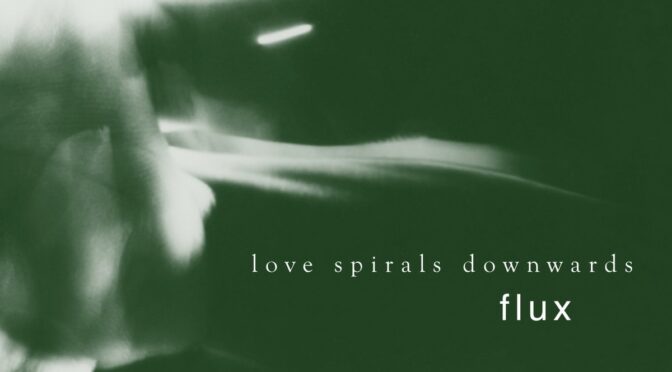
Having hinted at a more electronic direction with Ever, Love Spirals Downwards fully embraced this new sonic territory with their fourth and final studio album, Flux (1998). This marked the most dramatic transformation in the band’s sound, as Ryan Lum leaned into breakbeats, downtempo rhythms, and drum & bass textures — weaving them into the band’s signature ethereal framework.
By the late ’90s, Love Spirals Downwards had earned a reputation as “the darlings of Projekt Records,” a phrase used by press outlets like Underscope, Outburn, Losing Today, and RadioSpy to describe their status as the label’s best-selling and most celebrated act. Known for their angelic vocals, shimmering guitars, and atmospheric beauty, they had become synonymous with Projekt’s 4AD-inspired aesthetic. Flux, however, upended those expectations — trading acoustic balladry and ambient folk textures for layered beats, minimalist vocals, and sleek urban atmospheres.
Over time, Flux came to be regarded as one of the most forward-thinking releases in the Projekt catalog — a bold experiment that proved electronic music could coexist with dreamlike songwriting. It even reached mainstream ears when one of its tracks, “Psyche,” was featured on WB’s Dawson’s Creek in 2001.
From Shoegaze to Breakbeats: A New Sonic Horizon
While Ever had already introduced digital manipulation and electronic layering to the band’s shimmering guitar work and atmospheric layers, it remained a hybrid record, blending acoustic folk, ambient textures, and early electronic flourishes. Flux took it a step further, placing rhythm and electronic production at the core of the songwriting process.
Ryan Lum’s evolving musical direction was deeply shaped by his immersion in electronic music culture. In a revealing 1999 interview with DJ Gary Liu on the KUCI 88.9 fm radio program Riders of the Plastic Groove, Lum recalled the pivotal moment he encountered drum & bass:
“When LTJ Bukem’s ‘Logical Progressions’ came out, I guess it was 3 years ago or so, that was a life changing CD. It kinda ended our shoegazer sound we had, that Cocteau Twins/Slowdive thing on our previous album, ‘Ever.’ Our latest album, ‘Flux,’ is pretty much a drum n bass –at times downtempo– record. It’s all pop though, it’s got vocals, guitar, but it’s very inspired by drum n bass music.”
DJ Gary Liu contextualized this shift in broader musical trends:
“Well it seems to me that music itself has changed in that direction. If you look at it, the whole shoegazer scene has kinda faded away and drum and bass is being brought to the forefront, so you guys are just on top of it.”
Lum also spoke about audience reception:
“I was surprised by how few people seemed shocked by it! I guess people that liked our sound before -–if they truly liked it-– they like our new sound, too. It still has all the mood and feeling as our old music, it just has more drums. So as long as you’re not beatophobic—and there are those out there, trust me—I’ve met a few people who just can’t like our album because of the beats. They said, ‘Just get rid of the drums and I’ll like it,’ and I go, ‘It’ll be really boring then!’ So, assuming you’re not the beatophobic type, yeah, most people have gone along with it. I’m surprised by how many people think it’s our best record. I think it’s our best record.”
In a an earlier interview Daniel Bremmer for Fix (1998), Lum expanded on the influence of Good Looking Records:
“When I finish a record, I don’t like to make the next record sound like the previous one. I like to change things up. A few months after Ever, I started hearing LTJ Bukem and stuff off his label, like PFM, Seba & Lo-Tek, off the Logical Progressions compilation. It blew my mind in the sense that it was as beautiful and ethereal and pretty as anything I’ve ever listened to –like the Cocteau Twins– and yet it was definitely electronic music. It’s the perfect fusion of beauty and bliss and electronica. That was an inspiration.”
By the time Flux was recorded, Lum was fully embracing electronic production, drawing inspiration from trip-hop, drum & bass, and downtempo artists who incorporated sampling and looping into their music. His favorite albums of 1998 reflected this shift:
- Massive Attack – Mezzanine (a key inspiration for Flux’s darker, atmospheric grooves)
- Air – Moon Safari (which helped shape the album’s downtempo, dreamy aesthetic)
- Perfume Tree – Feeler (a clear parallel to Flux’s fusion of trip-hop, drum & bass, and ethereal vocals)
- LTJ Bukem – Earth Vol. 3 (reinforcing Lum’s passion for ambient drum & bass and downtempo textures)
- Soundtrack to Pi (notable for its blend of electronic beats and haunting atmospheres)
These influences shaped not only Flux’s tone and tempo but also Lum’s production techniques—particularly his use of sampled, looped, and fragmented vocals, a hallmark of artists like LTJ Bukem’s Good Looking Records crew, Massive Attack, and Perfume Tree.
Building Flux: The Start of a Digital Revolution
Unlike Love Spirals Downwards’ earlier albums, which were recorded entirely on analog 8-track tape, Flux marked a turning point in the Lum’s production process. While sometimes described as a digital album, in reality it was a hybrid creation, bridging the warmth of analog recording with the flexibility of emerging digital tools. This approach not only reflected the late-’90s technological shift in music production but also mirrored the album’s title—Flux—a work in constant transition between past and future.
Ryan Lum sequenced the album’s MIDI foundation in Cubase on a Mac Quadra 605, using an Ensoniq ASR-10 sampler to build drum loops and vocal textures. These digital elements were then synchronized with analog recordings on a Sony MDM-X4 MiniDisc multitrack, which allowed him to integrate the two formats seamlessly. Guitars and vocals were tracked to analog tape, while synthesizers like the Roland Juno-106, Korg Prophecy, and Roland TR-606 added lush atmospheres and rhythmic drive. Everything was ultimately mixed down to DAT, maintaining the analog depth that had always defined Love Spirals Downwards’ sound.
In a 1999 Sony Soundbyte interview, Lum explained why the MDM-X4 became central to the process:
“For Flux, I chose the Sony MDM-X4 because it allowed me to sync vocals seamlessly with my MIDI tracks and offered hard disk-like editing, which let me copy and paste audio and rearrange songs after recording. For example, on ‘Ring,’ I added a guitar solo after the vocals were done, simply by adding a track.”
The MDM-X4 was what Lum later described in Chillin’ with Lovespirals (2025) as “a little mini-disc kind of recorder”—used mainly for vocals within a larger analog setup. As he recalled:
“It was mainly tape with a synchronized little MiniDisc recorder for vocals. It was a hybrid setup, but there were more non-digital tracks than digital tracks by far.”
This hybrid workflow gave Lum the freedom to experiment with editing and arrangement while retaining the tactile qualities of tape. On KUCI’s The All Purpose Nuclear Bedtime Story (1998), he described how this changed his approach:
“Right now it’s tapeless. The kind of music I make, it’s great for that, ’cause I’m always cutting and pasting stuff all over the place. I rarely ever lay down four minutes of an instrument. I usually just put down a little bit and move it all around.”
By combining digital sequencing with analog tracking, Lum created a workflow that encouraged experimentation without sacrificing warmth or atmosphere. As he told MacNetV2 in 2001:
“The MIDI sequencing for Flux was done on a Quadra 605 using Cubase, but the rest was recorded to analog and mixed down to DAT. I mastered Flux on a Mac setup at Robert Rich’s studio.”
In Keyboard Magazine (1999), Lum summed up his creative philosophy:
“Getting new gear—for me—is what makes records. I am just amazed at how much great stuff is out there. It’s such a fun time to be making music.”
Ultimately, Flux’s production stood at the crossroads of two eras—the warmth of analog tape meeting the precision of digital editing. That duality not only defined its sound but perfectly embodied the state of Love Spirals Downwards at the time: evolving, experimental, and in transition.
Vocal Sampling as an Artistic Evolution
As Flux moved further into electronic territory, Lum’s approach to vocals evolved alongside the beats. Rather than structuring songs solely around traditional melodies, he sometimes used Suzanne Perry’s voice—or those of other collaborators—more as textural components to serve the mood of the track.
This sample-driven strategy is especially evident in:
- “Nova” – A largely instrumental piece with a single, heavily processed vocal sample, creating a hypnotic, atmospheric bridge.
- “I’ll Always Love You” – Repeats the word “misunderstood” throughout the arrangement in lieu of full lyrics, mirroring the minimalist phrasing used by many downtempo and drum & bass artists.
- “Sound of Waves” – Features Perry’s ambient vocalizations without clear lyrics, repeating like a meditative flow over downtempo rhythms.
- “Sunset Bell” – Originally recorded in 1994 with Jennifer Ryan Fuller, later reimagined by Lum using her “la la la” vocal loops in a trance-like arrangement.
Still, Flux was not entirely dependent on sampled vocals. Several tracks—”City Moon,” “By Your Side,” and “Alicia”—featured full, structured vocal performances from Perry, connecting back to Love Spirals Downwards’ earlier songwriting approach while blending seamlessly into the album’s electronic evolution.
City Moon – An Unlikely Anthem
More than two decades after its release, “City Moon” has become the most-streamed Love Spirals Downwards track on Spotify and Apple Music—despite never being released as a single, having a video, or even being performed live. Its unexpected popularity underscores the enduring resonance of Flux and its ability to find new listeners long after its initial release.
As the album’s opener, “City Moon” sets a relaxed urban-meets-celestial atmosphere. A 53-second instrumental introduction blends mellow acoustic guitar, gentle trip-hop beats, and Lum’s trademark shimmering electric textures before Suzanne Perry’s vocals enter with the wistful line: “Oh oh oh / Bad moon / You were more to me.”
The chorus—“And yellow time is overhead / Unchanging things imprinted / Can it all be clear?”—introduces the album’s recurring themes of time, memory, and longing. Perry’s delivery, airy yet direct, makes the song feel like both a lullaby and a meditation.
Adding to its legacy, “City Moon” was included on the sixth and final volume of Hyperium Records’ influential Heavenly Voices compilation series in 1998. This placement marked a fitting full-circle moment: Hyperium had played a pivotal role in introducing Love Spirals Downwards to European audiences, releasing their first two albums in Germany and featuring them on numerous compilations throughout the 1990s. Its selection for Heavenly Voices VI affirmed that, even as the band leaned toward sleeker electronic textures, their music remained deeply rooted in the ethereal wave tradition.
Alicia – A Flamenco-Tinged Dream
Among Flux’s more vocally prominent tracks, “Alicia” stands out with its layered vocal harmonies and evocative use of language. While Ryan Lum’s production embraces drum & bass rhythms, Suzanne Perry’s performance retains a melancholic, ethereal quality that anchors the song in dream-pop territory.
Perry’s lyrics—an inventive blend of genuine and imagined Spanish-inspired phrases—continue her established practice of weaving foreign fragments with made-up words, a technique also heard in “Mediterranea,” “Dead Language,” and “Lieberflusse.” This approach enhances the song’s mystique, giving it the texture of a dream where sense and sound intertwine.
The chorus line “Bella quartava / Su sol / Hiereme” (roughly, “Beautiful room/quarter / Its sun / Wounds me”) conveys both longing and vulnerability. Whether “quartava” suggests a room, a quarter of time, or simply a stylized mutation of cuarto/quarto, the imagery speaks to Flux’s recurring themes of transformation, impermanence, and emotional distance.
Adding to the song’s richness, guest musician Rodney Rodriguez (of The Von Trapps) contributes a flamenco-tinged acoustic guitar solo. Named after Rodriguez’s soon-to-be-born daughter, “Alicia” merges unexpected influences—drum & bass with Spanish guitar—resulting in one of Flux’s most strikingly experimental moments.
By Your Side – A Soulful Departure
Midway through Flux, “By Your Side” stands out as one of the album’s most emotionally open and lyrically direct moments. Stripping away the layered harmonies and gauzy effects that often defined her vocals, Suzanne Perry delivers in a lower register—raw, restrained, and intimate. The result is a grounded performance that contrasts with her signature heavenly voices style.
Lyrically, the song shifts from Perry’s usual abstraction to a more immediate, yearning tone. Where “City Moon” and “Alicia” evoke dreamlike surrealism, “By Your Side” dwells on intimacy and distance, using water and celestial imagery as metaphors for devotion and separation:
“Crossing this ocean’s too wide / How could that warmth be the right sky / Crossing to be by your side / Right by your side.”
While lines such as “How could that warmth be the right sky” preserve a sense of mystery, the repeated refrain of “right by your side” brings emotional clarity. The track’s directness makes it a rare moment of unguarded expression on Flux.
Ryan Lum has cited Walking Wounded by Everything But the Girl (1996) as a favorite alongside Perfume Tree and LTJ Bukem—suggesting that the fusion of soulful vocals with electronic backdrops influenced Flux. Perry’s understated delivery here recalls Tracey Thorn’s restrained yet deeply expressive style.
Critics later highlighted this vulnerability: Autech, writing for Hypnaogics in 2011, noted the song’s “flat vocal tone only makes it more endearing,” especially against the heavily produced soundscapes of its era. Jason Moore, in the 2024 Flux vinyl liner notes, emphasized how the imagery of movement and longing reflects the album’s thematic shift:
“The environments conjured up by Flux may be considerably more sleek and urban, but they’re no less evocative, particularly when Perry sings… ‘I’d cross the ocean / Just to be there by your side / I’ve felt the water / As its river flows to dry.’”
Even as Flux departed from the band’s earlier shoegaze- and folk-infused textures, “By Your Side” demonstrates how Perry’s voice—stripped back, lowered in tone—could still conjure the haunting beauty at the core of Love Spirals Downwards’ legacy.
Kristen Perry – Mythology and Mainstream Reach
One of the more intriguing aspects of Flux was the quiet return of Kristen Perry—Suzanne’s sister and Ryan Lum’s original vocal collaborator before Love Spirals Downwards solidified as a duo. Though credited in the liner notes for vocals on “Psyche” and “Ring,” her involvement went unmentioned in promotional materials, leading many listeners to assume all vocals were Suzanne’s. Attentive fans and critics noticed otherwise, with Carpe Noctem pointing out:
“One interesting aspect of Flux is that one of the two additional vocalists—whose timbre seamlessly dovetails with Suzanne’s—just happens to be her sister.”
Kristen didn’t just contribute vocals—she brought a distinct lyrical voice to the album, one grounded in poetry and mythology. Her presence offered a fresh narrative clarity at a time when Suzanne was becoming less involved in the creative process. The myth-inspired “Psyche” reimagines the Greek tale of Psyche and Eros, meditating on suspicion, revelation, and love:
“I held the lamp, suspicion beheld me his face / I loved him blindly, never saw his face by day.”
“Ring,” meanwhile, channels Celtic folklore and Yeatsian mysticism:
“Come away, with me, oh human child / To the waters and the wild / With a faerie hand in hand.”
A 2011 review on the Hypnaogics blog praised both tracks as emotional highlights. “Psyche” was described as capturing “all the elements of Flux that makes it such a good album,” with Kristen’s vocals made “more intelligible and affecting” by their minimal delay effects. “Ring,” the reviewer argued, was the album’s most emotionally sincere moment: “If you were only to listen to one track off of Flux, this would be it.”
Kristen’s songs also brought Flux one of its most unexpected breakthroughs. “Psyche” appeared in the Season 5 premiere of Dawson’s Creek, “The Bostonians” (October 10, 2001), reaching 4.47 million viewers in over 50 countries. Its placement introduced Love Spirals Downwards to a broader audience and extended Flux’s lifespan through syndicated airings and DVD releases.
Together, “Psyche” and “Ring” provided lyrical and emotional clarity that contrasted with Flux’s more abstract, sample-driven textures. Their storytelling weight only heightens the poignancy of what follows: the album’s final track, where language itself dissolves into pure tone and atmosphere.
Sunset Bell – From Serendipitous Loop to Psychedelic Lullaby
Closing Flux on a hypnotic note, “Sunset Bell” stands as one of the most transformative and forward-reaching pieces in the Love Spirals Downwards catalog. Its roots stretch back to 1993, during the Ardor sessions, when guest vocalist Jennifer Wilde (then Jennifer Ryan Fuller) improvised a series of wordless vocal loops. As she recalled on her blog:
“I was just fooling around with the microphone and the looper, and all of a sudden I noticed Ryan was recording. ‘What are you doing?’ I asked. ‘Just keep going,’ he whispered.”
That impromptu session became the original “Sunset Bell”—a drifting ambient piece built entirely from Wilde’s loops and subtle studio treatments. In a 1994 Projekt Records interview cassette, Ryan Lum reflected on how radical it felt:
“I don’t think there’s any guitar in that song, actually… It’s technically not an instrumental, but in my mind, I think of it as an instrumental just because the vocals… are not live, they’re just these big loops of vocals that sound like instruments for the most part.”
For Flux, Lum returned to those recordings with a new perspective and an expanded digital toolkit. Resampling Wilde’s loops, he layered effects, rhythms, and atmospheric textures into an eight-minute composition that blurred ambient, trance, and post-rave psychedelia. Wilde herself praised the reinvention:
“This is a remix of the song I recorded with Love Spirals Downwards for the ‘Ardor’ album. I have to say that this version is a marked improvement.”
Critics agreed. Hypnaogics in 2011 described it as “a loopy psyched-out bliss track, in the vein of the first two Seefeel records… At 8 minutes it is the longest track on the album, but no time is wasted.” The comparison to Seefeel was no accident: Lum was increasingly influenced by the electronic underground. As he told Keyboard in 1999:
“I’m used to making pop songs, like an A section, a B section, but half the songs on ‘Flux’ don’t follow that traditional pattern. It’s like having all these different parts and having them make sense as they flow together.”
Lum’s shift was rooted in his late-’80s move from the Los Angeles goth scene into the acid house underground. In Isolation (1993), he recalled:
“Most bands I remember from 1989 sounded like they were still living in the early ’80s… I remember myself and others leaving that whole scene and headed for the then-new acid house clubs such as Alice’s House. Colorful psychedelic lights, blacklight/day-glo rooms, and hypnotic trance-inducing music were a welcome new treat for my bored senses.”
By the late ’90s, this fascination had deepened into a spiritual connection with dance culture. On KUCI’s All-Purpose Nuclear Bedtime Story in 1998, Lum described:
“The last cool one was up on a mountain top… There were about 80–90 people dancing ‘til the sun came up. Very, very spiritual. I’ve been dancing since acid house in ’89. I’d dance for hours. It’s a very spiritual activity, I gotta tell ya.”
This ethos—the merging of ambient textures with trance rhythms—finds its fullest expression in the Flux version of “Sunset Bell.” In 2024, NTS Radio spotlighted the track on an In Focus program, playing both Ardor and Flux versions back to back, tracing its evolution from lo-fi loop experiment to immersive electronic statement.
Its influence has only grown. In 2025, “Sunset Bell (Flux Mix)” appeared on Infinite Sonore, a 3-LP compilation curated by Swiss DJ Princess P and released by Mental Groove. The collection, featuring Spacemen 3, Natalie Beridze, and LFO, was billed as “a transcendent musical voyage… blending electronic dreamy soundscapes with ecstatic rhythms that move seamlessly from the dancefloor to introspective moments.”
The track has even picked up cult associations beyond the music world, with fan communities widely reporting its appearance in La Femme Nikita (Season 3, Episode 5, “Imitation of Death”). While uncredited, citations on Wikipedia, IMDb, and Discogs testify to its lasting mystique.
From a chance studio improvisation in 1993 to a psychedelic lullaby embraced by post-rave culture decades later, “Sunset Bell” embodies Love Spirals Downwards at their most adventurous. It closes Flux not with resolution, but with dissolution—language giving way to pure tone, drifting toward the infinite.
Creative Tensions Arise: Suzanne Perry’s Role and Flux’s Evolution
Despite its critical acclaim, Flux marked a turning point for Love Spirals Downwards—both musically and personally. As Suzanne Perry began focusing more on her post-graduate career in social policy research, her involvement in the band’s creative process naturally lessened. In contrast, Ryan Lum was diving deeper into electronic production, embracing a direction he had long wanted to explore.
In a phone-in interview with The All Purpose Nuclear Bedtime Story on KUCI, recorded just before the album’s release, Lum spoke about the intensity of his work on Flux:
“After the album’s done next month I can start doing other fun things that I’ve been putting off out of necessity. I’m just trying to direct all my energy, my momentum into finishing this record up. I’ve been working pretty hard on it for about a year—really hard since summer—and I just wanna finish it.”
Lum’s increasing commitment had been building for years. On Ardor, he used studio tricks and a guest vocalist to fill in while Perry prioritized her master’s program; on Ever, he began exploring samplers and digital production. By the time of Flux, that process had reached full maturity. Meanwhile, Perry was becoming less involved—not necessarily due to lack of interest, but due to other life priorities.
She acknowledged this herself in a 1995 Muse interview:
“I have a professional life that’s very analytical and my leisure, which is singing. Love Spirals Downwards is really confined to this one part of my life, to specific circumstances.”
And in Paradigm Shift that same year, she was even more candid:
“I don’t even remember that I do music most of the time. It’s not like I’ll be at work or in my regular day and I’ll think about music, or a song, or performing, or anything—unless I’m worried about it.”
Lum echoed her perspective, stating:
“Suzanne only works on music once in a while. It’s usually me that is constantly working on stuff.”
As Flux was being written and recorded, the divide between their creative priorities widened. Perry admitted in Fix:
“Usually, it’s more of a collaborative effort. It’s not that this one wasn’t, but he took it in directions that I wouldn’t necessarily have gone if I was there at every moment. It’s more of Ryan’s work. It’s something that he fashioned out of his own likings.”
As Suzanne’s involvement waned, her sister Kristen Perry re-emerged, stepping in as both a vocalist and a songwriter. Lum added in the same interview:
“I don’t think Suzanne was as easily able to make parts for this kind of music as she was for the more acoustic-based music. Her sister, on the other hand, was making up parts left and right, so it kind of worked out.”
In a 2023 YouTube feature about the Flux Deluxe Edition Lum elaborated further on Kristen’s involvement:
“I’m sure something many people wonder about Flux is why Kristen Perry — Suzanne’s sister — is on two of the songs. It’s a really simple reason: those were two of the songs I was really excited about and really wanted to be on Flux, but for some reason or other, Suzanne had creative blockages with those songs. She really just couldn’t come up with anything that she was satisfied with, but I didn’t want those songs to die. I was really determined they had to come out. I knew they were great songs, so I said, ‘Alright, Kristen, you want to try working on a couple songs with me that Suzanne had trouble with?’”
While Kristen’s reappearance was not widely promoted at the time—she was credited only in the liner notes—it wasn’t the first time she had worked with Lum. Before Love Spirals Downwards formally began, Kristen had collaborated with him, which Suzanne referenced in a 1992 Altered Mind interview:
“It’s funny because I was in London at the time going to school, and he was sending me tapes with my sister on it, and I thought, ‘I can sing that. In fact, I can sing that better!’ Then I kind of came back, and we started doing it.”
The dynamic between the sisters was occasionally mentioned in interviews with some light teasing. In Fond Affexxions, interviewer Jon Gonzales joked, “Not your sister again, not the sibling rivalry again!” Suzanne responded simply: “I know, I know.”
But rather than rivalry, the bigger picture was one of transition. Suzanne’s role was becoming more selective, while Lum was increasingly immersed in production—enough that he considered how to perform Flux material live without her. “I was gonna play some of our new stuff without Suzanne,” he admitted on The All Purpose Nuclear Bedtime Story, “just come and play the music and samples of her and other stuff, and kinda rock that all together live.”
Speculation about a creative divide began to surface. A nationally syndicated Echoes feature in late 1998, titled “Love Spirals Downwards – Music & Minds in Flux,” introduced the album with unusual candor:
“Flux is their first album since they broke up as a couple, and the trip-hop beats seem to represent the fracturing of their relationship. We gather them both in a room to sort out a group in flux.”
Because the episode aired only on terrestrial radio and was never archived, many fans missed this acknowledgment at the time. The full extent of the shift didn’t become clear until much later—most explicitly in the 2024 vinyl reissue. In new liner notes for that edition, Jason Morehead of Opus Zine reflected:
“By the time Flux was recorded, Lum and Perry’s relationship had ended, and disagreements over the music only deepened the divide. Shortly after its release, they went their separate ways.”
This perspective reframed Flux not only as a sonic evolution but as a creative and emotional crossroads—the closing chapter of one of Projekt’s most resonant collaborations.
Love Spirals Downwards’ Final Live Performance: ProjektFest ’98
Love Spirals Downwards’ final live concert took place at ProjektFest LA on March 15, 1998, at the El Rey Theatre in Los Angeles. Organized by Projekt founder Sam Rosenthal, ProjektFest was a rare showcase of the label’s mostly studio-focused artists performing live. However, Ryan Lum had expressed mixed feelings specifically about these festival shows, noting in a January 1998 blog post:
“Some of you know that Suzanne and I are not exactly blissful about festival shows, so this will be our last festival performance and your last opportunity to see us at one.”
For this final ProjektFest appearance, Lum assembled a hybrid live band: Rodney Rodriguez (guest guitarist on “Alicia”), Drew Pluta of Arcanta on electronic drums and backing vocals, Suzanne Perry on vocals and egg shaker, and Lum himself alternating between acoustic guitar and bass. DAT tracks filled out the electronic components, blending new material from Flux with acoustic renditions of earlier songs.
The most surprising moment came during the encore—a ghostly cover of Fleetwood Mac’s “Dreams.” Perry’s ethereal vocal delivery and Pluta’s harmonies marked a notable departure from the festival’s typical lineup.
While the show was generally well received, Outburn magazine’s review noted that Perry’s extended onstage chatter occasionally disrupted the mellow mood, but the songs were enjoyed nonetheless.
Friction at ProjektFest: Suzanne Perry’s Comments on the DJ and the Band’s Identity Crisis
The tension surrounding Love Spirals Downwards and the Projekt scene came to a head during ProjektFest ’98, not only because of the band’s evolving sound but also due to their uneasy relationship with the goth and darkwave subculture. Despite being signed to Projekt and embraced by ethereal music fans, Love Spirals Downwards had never identified with the goth label some ascribed to them.
Following the festival, Suzanne Perry openly criticized the Coven 13 DJ who had worked with Projekt to curate and promote the event:
“He’ll play the same records next week, and the week after, and the week after that! As though he has not been playing them since 1985 or something? That’s pathetic. I’m embarrassed for those people.”
Her comments highlighted a broader frustration with what she saw as the scene’s stasis and insularity. Combined with the unconventional sonic palette of Flux—which even Projekt founder Sam Rosenthal initially questioned as fitting the label’s signature aesthetic—Perry’s remarks added fuel to the perception that Love Spirals Downwards was distancing itself from Projekt’s core audience.
Ryan Lum reflected on this tension in a 2000 interview, noting that although Flux was so different from anything else on the label, they were given artistic freedom:
“It’s not his cup of tea, but we more or less have artistic freedom to do as we please. We proved with Flux—even though we made an album that’s so different from anything else on the label—people didn’t complain.”
Despite the doubts, Flux found an audience. Listeners proved more open to change than some had feared.
The Last Live Radio Set and Interview: KUCI’s Space Disco for Fish Tacos
Several months after ProjektFest, on December 16, 1998, Love Spirals Downwards performed their final live set on KUCI 88.9 FM’s Space Disco for Fish Tacos. Using DAT backing tracks, the brief hybrid set featured songs like “Alicia” and “Sound of Waves,” marking the last live performance by the band.
Following the performance, Suzanne Perry engaged in a candid and sarcastic interview with DJ Daniel Bremmer (aka 9-5 Superspy), who had conducted the earlier Fix magazine interview. In response to how the band tensions were portrayed in Fix and the Echoes radio show, Perry quipped:
“Let’s talk about how good that album is… My promotions people have talked to me. I love it. Everything is so great! That’s what people want to hear—how wonderful everything is and what a wonderful process it was making the album. They don’t want to hear the truth.”
Yet she also offered a more balanced perspective on the album’s reception and the band’s uneasy place within Projekt:
“I think one of the big issues is it’s not maybe a Projekt-y sound, you know, and I think that has made the whole thing more controversial. So people have jumped on this thing that ‘Suzanne doesn’t like it and Ryan does!’ You know? I don’t know.”
This interview, paired with the final live radio set, served as a closing chapter for Love Spirals Downwards as a traditional band, highlighting the growing creative and personal distance between Perry and Lum.
Remixing Flux: Lum’s Expansion Into DJ Culture
With the conclusion of Love Spirals Downwards’ live performances, Ryan Lum shifted his focus toward electronic music DJing, embracing the emerging culture with enthusiasm. Lum brought the spirit of Flux into clubs, underground spaces, and radio airwaves through a series of DJ sets focused on downtempo, drum & bass, and atmospheric electronic music.
Between 1998 and 2000, Lum spun sets at venues such as Spaceland in Los Angeles, La Belle Epoque in San Francisco, and Virgin Megastore in Hollywood. He was a recurring presence at electronic music nights like Nightnoise, Dervish, and Sterile, and performed at larger events including Caffeinated at the Museum of Contemporary Art Santa Barbara, the B-Sides Y2K Party in Big Bear, and Family’s 6th Year Anniversary in Los Angeles. His DJ reach extended to radio as well, with guest spots on KUCI 88.9 FM’s Space Disco for Fish Tacos, Riders of the Plastic Groove, and The All Purpose Nuclear Bedtime Story.
Lum spoke about this transition in a 2000 KUCI interview:
“I’ve always wanted to [DJ] and I finally said, ‘I’m just gonna do it!’ It’s cool to go from music into deejaying… I think it’s cool to already know about music, how to make music, how to play instruments… something DJs usually don’t know how to do.”
As the internet was just beginning to support audio streaming, Lum embraced this new frontier. In early 2000, he uploaded a mix titled Atmosphere ’99 to Live365.com, categorizing it under Jungle and Dance. The mix was featured in March 2000 on RadioSpy—a short-lived but forward-looking streaming platform run by the creators of GameSpy. RadioSpy’s spotlight on Love Spirals Downwards included an audio interview with Lum and a direct link to his Live365 mix.
In that feature, Lum expressed his excitement about the future of online music distribution:
“I’m glad now, finally, that broadband is coming, so we can pump more bandwidth to people… RadioSpy is a great example of how the Internet is finally ready for audio—or audio is ready for the Internet. Now’s the time.”
A month later, on April 14, 2000, Lum performed a live online DJ set for the eclectic streaming show Dinner With a DJ, hosted at the virtual Love Cat House. His participation in this early web-radio event further demonstrated his eagerness to connect with fans through new technology, even before digital music distribution had gone mainstream.
By exploring both traditional club spaces and online platforms, Lum helped extend Flux beyond the confines of a studio album—reimagining it as part of a living, evolving set of sounds shared in real time.
A Bold Departure: The Acclaim for Flux
Though Flux marked a dramatic departure from Love Spirals Downwards’ earlier work, it was widely acclaimed:
- Pitchfork (1998): “Within minutes of listening to this disc, you’ll think that Love Spirals Downwards has been doing this for years and everybody else is just way behind the times.”
- Option Magazine (1998): “A great, contemporary record. It’s one of the best things I’ve heard in months.“
- Carpe Noctem (1998): “Flux may just elevate the band into a broader realm of exposure beyond the goth scene.”
- Keyboard (1999): “An album of uncommon character. The organic feel of Lum’s experienced guitar playing smooths out the gushing beats by adding mellow polyrhythmic contrast.”
- URB Magazine (2000): “A seamless hybrid of trip-hop, dream pop, and drum & bass.”
- Opus Zine (2000): “Incredibly listenable and quite beautiful. I’m quite taken by this, and it’s probably one of my favorite albums to come out on Projekt.”
Additionally, Flux was featured in Borders listening stations from September through mid-November 1998 across all Borders locations, as well as in listening stations at select Virgin, Media Play, and Tower Records stores.
Flux tracks appeared on a number of compilations, further extending the albums reach. Notable inclusions include:
- The Projekt Sampler (1998) — “By Your Side”
- Heavenly Voices Part V (1998) — “City Moon”
- Carpe Noctem 1 (1998) — “By Your Side”
- Loraine: A KUCI 88.9FM Benefit Compilation (1998) — “Nova”
- Diva X Machina 3 (2000) — “Alicia (1999 Remix)”
- Heartbeats (2000) — “Psyche”
- All Night Long in London (DJ Mix) by Avalon Emerson – “City Moon (Mixed)”
- Infinite Sonore by Princess P. (2025) – “Sunset Bell (Flux Mix)”
Resonance and Reissue: The Enduring Legacy of Flux
Though initially divisive, Flux has grown into one of the most beloved and forward-thinking albums in the Projekt catalog, resonating with new generations of listeners and earning renewed recognition for its genre-defying sound.
In 1999, DJ Gary Liu noted on KUCI’s Riders of the Plastic Groove that shoegaze was waning while drum and bass was gaining momentum—making Flux’s electronic direction feel prescient. Ryan Lum agreed, calling it “pretty much a drum n bass—at times downtempo—record” with pop sensibilities. The album’s fusion of genres positioned Love Spirals Downwards at the leading edge of a shifting musical landscape.
In a 2011 blog post on Hypnaogics, the album was hailed as “an interesting piece of crossover music history,” with the reviewer noting:
“It is strange to me that this blend of genres exhibited wasn’t emulated by other musicians, but maybe that’s what makes this album so memorable.”
That sense of lost opportunity was echoed two years later by Walter of Fietsers Afstappen, who published a blog titled Flux: The Album That Should Have Been a Genre. He wrote:
“Fifteen years on, Flux remains a uniquely brilliant album, a potential genre-defining masterpiece that, tragically, never spawned the imitators it deserved. Its blend of danceable yet atmospheric beauty is unparalleled, and its descent into relative obscurity is not just a shame, but a disgrace.”
In 2018, Post-Punk.com — a leading tastemaker in the darkwave and dream pop space — ranked Flux at #64 on its Definitive Dreaminess: 100 Essential Dream Pop Releases list, praising it as an album that “broke stylistic ground” for the California-based duo. The site wrote:
“Flux incorporated skittering, downtempo trip hop and drum & bass rhythmic elements, oddly rendering their music even more intoxicating and opaque. Tracks like the peerless ‘City Moon,’ ‘By Your Side,’ and pulsating epic closer ‘Sunset Bell’ felt like being trapped in a waking dream that you never wanted to end.”
This renewed attention helped usher in two long-anticipated projects: the Flux Deluxe Edition and the album’s first-ever vinyl pressing.
Expanded & Remastered: Flux Deluxe Edition (Digital, 2023)
In 2023, the band released an expanded digital edition of Flux to celebrate the album’s 25th anniversary. Compiled by Ryan Lum, the Flux Deluxe Edition featured remastered audio, unreleased outtakes, remixes, a new version of “I’ll Always Love You” (featuring his current collaborator Anji Lum), and a rare live radio session. In addition to the nine original album tracks, the edition offered listeners a deeper look into the creative experiments and alternate directions explored during Flux’s development.
As Lum explained in a 2023 YouTube video:
“I’ve been storing all my DAT tapes — that’s what we used to mix down our albums onto back then — and Anji, my wife and my singer, she was going through the tapes and found the original 9 core songs for Flux. But in addition to that she found a plethora of unreleased songs from the Flux era. All these songs that for some reason or another didn’t make it to Flux. I’m figuring, ‘Why let these songs just die on these DAT tapes and never have anyone hear them?’ Because I was surprised. I haven’t heard most of these songs since 1998, and I was shocked by how good these songs were. I’m really excited to share these.”
The moment also carried a sense of full-circle closure. Anji Lum — then known as DJ Anji Bee — had originally interviewed Ryan on KUCI’s The All Purpose Nuclear Bedtime Story in 1998, where he first spoke publicly about the unused material. Now, 25 years later, she played a key role in unearthing those lost tracks for fans to finally hear.
In his 1998 interview on The All Purpose Nuclear Bedtime Story Lum explained:
“I had a few songs that I tossed away… There were some songs that just didn’t quite click. I think all the songs I tossed were early ones.”
Remastering the album for digital streaming gave Ryan the chance to revisit the original mixes with new tools, but also with deep respect for the original mastering, done by ambient musician Robert Rich:
“Back in 1998, I went up to visit my good friend and mastering engineer, Robert Rich, and he mastered the album. I was sitting there learning how he does it, and I picked up stuff over the years as I’ve had him master most of my albums since then. Fortunately for me, I had those original nine mastered mixes of Robert’s to use as my reference and I have to say, it’s very challenging to try and match what Robert did, because he did such a fine job on the 1998 masters. My job was not to, like, say, “I’m gonna make it even better!” I just tried to make a really nice mastering for the modern digital world.”
Flux Vinyl LP (Lost in Ohio, 2024)
In April 2024, Flux received its long-awaited debut vinyl release, issued by Lost in Ohio Records. The original nine tracks—remastered by Ryan Lum—were meticulously prepared for analog playback by Christopher Colbert of National Freedom, with lacquers cut by Lex van Coeverden at The Vinyl Room. The result was a pressing that brought new depth and clarity to the album’s pioneering fusion of dream pop and electronic textures.
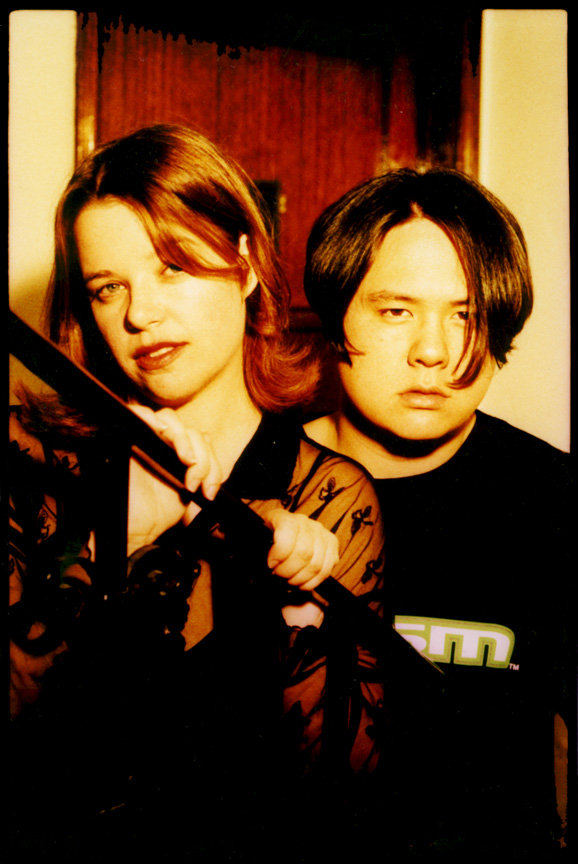
The vinyl edition featured a faithfully recreated jacket design and a limited-edition heavyweight white vinyl pressing. It also included a new insert sheet with a previously unreleased photograph of Ryan Lum and Kristen Perry, taken by Flux cover photographer Stuart Gow during the album’s original era. This image was originally considered for inclusion in the original Projekt CD release but ultimately set aside—until now. As Lum shared on Chillin’ with Lovespirals Episode 90:
“What’s really cool is this never-before-released photograph that was taken by Stuart, the same person who shot the photography for Flux. He shot this around the same time, too, thinking it might appear in the original 1998 release.”
The insert also featured a newly commissioned essay by Jason Morehead of Opus Zine, whose deep familiarity with Love Spirals Downwards’ catalog helped shape the narrative around Flux’s evolution. Lum praised the collaboration in the same podcast episode:
“That was great having someone who knew our work, as opposed to some guy just getting paid, doesn’t really care, as often happens for music reviews. He did an amazing job. So much so, I think Sam from Projekt Records… is trying to cajole him into writing a Projekt biography.”
For Lum, the vinyl release marked a milestone in his musical career:
“This is a huge thing. This is the first time I’ve ever had any of my albums come out on vinyl.”
The initial pressing quickly sold out, prompting a second, more limited repressing. On July 21, 2024, Lost in Ohio announced that a second run of white vinyl was in production, with shipping scheduled to begin on September 27. Lum commented on the surprise demand in Chillin’ with Lovespirals Episode 92:
“Most of these are going to stores, so stores can order 10 plus copies, who knows? So they can go pretty quickly.”
That second pressing helped meet growing demand from both collectors and specialty retailers. In December 2024, the UK DJ music site Juno featured the vinyl reissue on its Juno Recommends Balearic/Downtempochart, writing:
“Love Spirals Downwards’ seminal 1998 album, Flux, receives a well-deserved vinyl reissue, enriching its ethereal soundscape with newfound clarity and depth. The album’s lush blend of ethereal guitars, celestial vocals, and pioneering breakbeats resonates as powerfully today as it did upon its debut… and this vinyl reissue allows fans to rediscover its transcendent beauty once again.”
In addition to being featured on the Juno chart, the vinyl was stocked by high-profile outlets like Turntable Lab and Victrola, and appeared at independent record stores across the U.S., including End of an Ear in Austin, Electric Fetus in Minneapolis, Music Millennium in Portland, and Twist and Shout in Denver. This renewed visibility affirmed Flux’s cross-generational appeal and ongoing relevance in the broader vinyl resurgence.
2025 brought another limited pressing of Flux, this time in a random color swirl made from 100% recycled colored vinyl, available as far and wide as even FYE, Target, and Walmart online stores.
But Flux’s rebirth didn’t end with digital physical reissues. The album’s afterlife—on DJ sets, curated playlists, and radio features—has only grown stronger.
A New Generation Discovers Flux
While Flux never spawned a wave of imitators, it has found a second life through DJs, radio specials, and curated vinyl compilations—resonating especially with those drawn to its lush hybrid of electronica and dream pop.
In 2022, Bored Lord included “Alicia” in an Apple Music Early Hours DJ mix, mixing it between The Future Sound of London’s “Dead Skin Cells” and Malcolm McLaren’s “About Her.” Rather than isolate the song, Bored Lord allowed Alicia’s rhythms and harmonies to melt into and out of the surrounding tracks—a fitting homage to Flux’s fluid aesthetic.
In December 2023, globally renowned DJ Avalon Emerson included “City Moon” in her five-hour All Night Long in London (DJ Mix), available on Apple Music, SoundCloud, and YouTube. Played between Antonio Carlos Jobim’s “Monte Flower” and Antena’s “Achilles (Phreak Plus One Typhoon Mix),” the track was reimagined in a fresh, tropical-baroque context—demonstrating just how adaptable Flux’s mood and groove truly are.
Then in early 2025, “Sunset Bell (Flux Mix)” was selected for Swiss underground DJ Princess P.’s Infinite Sonore 3xLP vinyl compilation. The album, which traced the edges of electronic dream music—from Spacemen 3 to Natalie Beridze—positioned Flux alongside acid house, IDM, ambient dub, and minimal wave rarities. The description read:
“A transcendent musical voyage… blending electronic dreamy soundscapes with ecstatic rhythms that move seamlessly from the dancefloor to introspective moments.”
This placement was more than symbolic: it marked Flux‘s arrival as a touchstone in the international electronic underground, where club culture and dream pop continue to overlap.
As Flux continues to captivate a new generation, the album’s reissues have renewed appreciation for the band’s genre-defying vision. While it marked the close of Love Spirals Downwards’ studio output, one final chapter remained—a retrospective that bridged past and present: Temporal: A Collection of Music Past & Present (2000).