

Idylls (1992), the debut album by Love Spirals Downwards, sits near the crossroads of early-1990s ethereal wave and dream-pop, where atmosphere is treated as structure and texture carries as much meaning as lyric. Released on CD and cassette by Projekt Records in the U.S. and on CD by Hyperium Records in Germany, it arrived following the duo’s compilation debut on From Across This Gray Land No. 3 — two tracks (“Forgo” and “Mediterranea”) that had introduced Ryan Lum and Suzanne Perry to the ethereal scene and led directly to a full album offer from Projekt.
The album’s sound is built around Lum’s acoustic and electric guitar work and Perry’s glossolalia-adjacent vocalizations, a pairing that invites comparison to prominent touchstones in the broader ethereal/darkwave continuum. At the same time, the record was framed by its label in deliberately impressionistic terms — Projekt Records described Love Spirals Downwards as “the unconscious mind of ethereal music” — and early commentary similarly emphasized dream-states and half-remembered imagery rather than conventional song narratives. Music From The Empty Quarter praised it as:
“Thirteen angelic tracks tripping through peaceful illusions and fantasies, only briefly accessible in dream-soaked memories.”
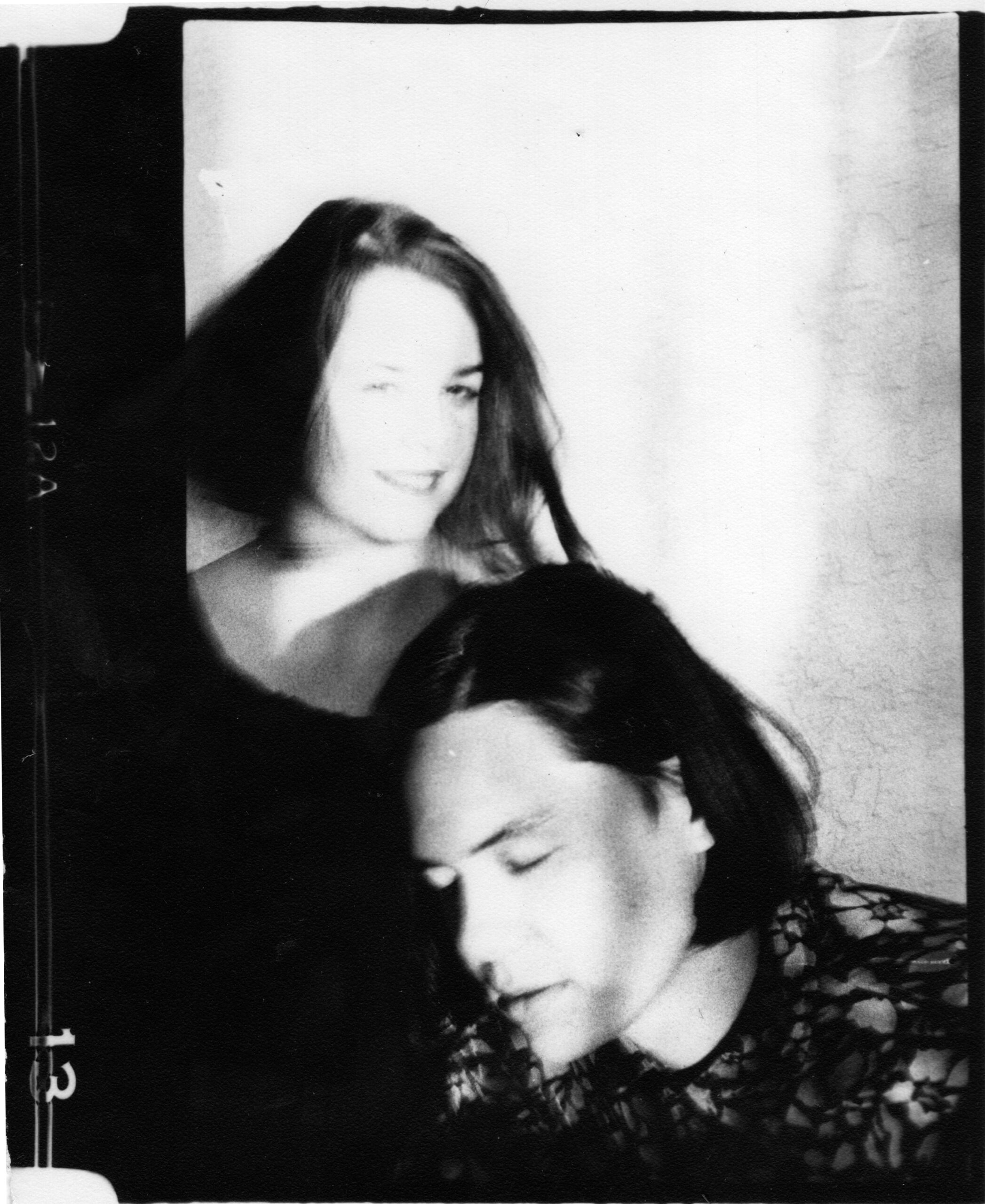
A Sound Already In Motion
Although Idylls introduced Love Spirals Downwards as a fully realized duo in 1992, much of its sonic architecture had been developing quietly for years before Suzanne Perry ever recorded a note.
Ryan Lum had been composing and recording in isolation throughout the 1980s, not with professional ambitions but as a deeply personal pursuit. In a 1993 interview with Fond Affexxions, he reflected, “I just made music. It’s been an important pursuit of mine over the past several years, but I never had any intention of pursuing music as a sort of career, on a professional level, I just always made music for myself. It made me happy.”
That private practice had a deliberate technical arc. In the same interview, he explained, “I had five plus years to mature in a songwriting and recording sense. I had a four track back in 1986 and I got the eight-track in 1989, but I’d been doing music long before 1985. I’ve been playing the guitar for like 15 years. By the time Suzanne came along, the music had evolved.”
He described himself humbly in Altered Mind (1992) simply as “more of a recording engineer than a guitar whiz,” and that engineering mindset shaped the album’s architecture: carefully stacked guitar lines, programmed drum patterns, synthesizer drones, and deliberate spatial depth created through reverb and delay –all assembled in a modest studio environment in a spare bedroom of his family’s home.
Perry, looking back in Tear Down the Sky (1993), gave the simplest summary: “He would make music and record it and not send it anywhere. He was cocooning.” Lum didn’t disagree: “I didn’t have a singer. I was doing it for myself as opposed to trying to be a famous rock star. It did something for me emotionally, that’s why I have and continue to do it.”
For Lum, making music and studying philosophy weren’t separate pursuits. As he told As If in 1993: “I notice that a lot of things that I’m deeply involved with in my life, such as making music and philosophy, I learn a lot from them. Making music is a part of my quest for understanding of the world. There’s something really revelatory about creating music, for me.”
Many of the compositions on Idylls had been evolving long before the album was recorded. The final stretch was a full-time effort. A 1992 interview with Ryan printed in Isolation (1993) explained that final push: “It seems to have been a very full time pursuit over the past summer. I have been putting a lot of work into finishing up the album; recording, mixing, getting artwork together, etc. But the album is coming along very nice. I am very pleased with all the songs and artwork so far.”
Looking back years later, he remained satisfied with what they had achieved. As he told DJ Anji Bee on KUCI’s The All-Purpose Nuclear Bedtime Story in December 1998, later published in Losing Today (1999): “A lot of the songs I had started on years before, and a lot of the songs I finished the year it came out, so really, it’s stuff I made between 1989 and 1992.” Asked whether he was satisfied with the result, he was characteristically straightforward: “Considering the primitive and limited gear I had back then, yeah. Sam [Rosenthal, owner of Projekt Records] didn’t give us a budget or anything, I just finished it all on my gear.”
By the time she stepped to the microphone, the musical framework was not tentative or embryonic — it had been evolving for years, and Perry was stepping into a sound that was already fully in motion.
Perry, reflecting on their working method in a 1992 Altered Mind interview, described how a song typically took shape: “He’ll usually do the whole music and play it for me, and I’ll come up with ideas, just notes and things, either on my own or with him.” Lum added, “Then we craft the vocals in with the music.”
“Then we record it, and we barely ever play it more than what’s done in the studio,” Perry continued. As Lum explained, “We’re recording artists as opposed to performing artists.”
That dynamic is central to understanding Idylls. Rather than documenting a young band discovering its identity in public, the album captures a convergence: years of Lum’s private refinement meeting Perry’s studio instincts. Love Spirals Downwards wasn’t born in rehearsal rooms or on stage—it emerged as a recording project, built layer by layer on tape.
A Tapestry of Influences: Ethereal, Psychedelic, and Beyond
Love Spirals Downwards emerged during a pivotal moment for ethereal and dream-pop music, when acts like Dead Can Dance and Cocteau Twins were defining the genre with their explorations of sound, texture, and emotion. Lum’s approach to composition was deeply informed by this movement but also drew on a wide range of influences. As he explained in Isolation (1993), “I believe that all the different types of music that I have listened to throughout the years—such as ethereal, ambient, East Indian classical, psychedelic ’60s, and tribal percussive—have been blended into our eclectic sound.”
Lum’s intricate guitar textures, inspired by the Cocteau Twins’ shimmering soundscapes and the psychedelia of 60s bands like Jefferson Airplane and Popol Vuh, serve as the foundation for the album’s otherworldly atmosphere. Altered Mind lauded this combination of artistry, stating in a 1993 review:
“The perfect pairing of Suzanne Perry’s ethereal siren vocal and Ryan Lum’s intricately crafted instrumentation. The sound is soothing, uplifting, and energizing all at once, and is marked by both delicacy and force.”
This meditative, transportive quality became a hallmark of Idylls. Lum’s musical tastes were particularly shaped during the mid-1980s, a period he identified as his favorite in a 1993 Fond Affexxions interview: “I remember discovering Cocteau Twins, when Love’s Easy Tears came out. I guess in like ’86 or ’87. and then going back and hearing Victorialand. 4AD was in its ‘Golden Age’ and everything was so magnificent. I started finding all the Harold Budd, Brian Eno stuff, Dead Can Dance, Cocteaus… Before that I liked some of The Cure stuff; their first three or four albums.”
While Perry’s vocal style is often compared to Elizabeth Fraser or Lisa Gerrard, her influences extended beyond the realm of ethereal wave. In the early 90s, Ryan Lum introduced her to Indian classical music, taking her to live concerts at Occidental College, where she absorbed the vocal techniques and phrasing of Indian singers. Lum recalled in a 1992 Altered Mind interview, “We go to see the Indian concerts at Occidental College. We always try to look for really percussive bands, for lack of a better term, or ones that have really strange sounding string instruments, or ones that have nice vocals for her to listen to.”
This exposure may have shaped her use of improvisational syllables and phonetic abstraction, particularly in tracks like “Dead Language.” In a 1993 Fond Affexxions interview, Perry acknowledged incorporating “some Indian too, make-believe Indian” into her lyrics—suggesting that she absorbed and reinterpreted these influences in her own way.
Suzanne Perry: Vocal Instrumentalist and Lyrical Philosophy
Suzanne Perry’s role in Love Spirals Downwards was shaped not by conventional songcraft but by a fundamentally instrumental approach to the voice—one that emerged directly from the duo’s studio process rather than from any pre-existing lyrical practice.
In the letter accompanying their three-song demo submission to Projekt Records, the duo had already staked out the position plainly:
“In breaking with more conventional vocals, we completely abandon the use of language as a conveyor of thought and emotion in hopes that the entire musical piece, instrumental and vocals, work as one artistic expression.”
Everything that followed in the studio—and in the interviews that accompanied Idylls—was follow-through on a founding intent.
The philosophical grounding of that position wasn’t incidental. In a 1993 Tear Down the Sky interview, Lum described his current academic focus as “the philosophy of language, the nature of reference, and meaning of words” — a field directly concerned with how language does and doesn’t carry meaning. That he was working through these questions in the classroom while articulating a studio practice built around abandoning language as a conveyor of thought gives the demo letter’s phrasing a particular precision: it wasn’t a marketing pitch, it was a position.
Perry described her studio-based method in a 1992 Altered Mind interview: “We manipulate the equipment, and then we don’t do it unless we’re in the studio. Sometimes we’ll hum the song or something, but it’s really in the room that we do most of the stuff. It’s really un-bandlike.” That word—”un-bandlike”—captures the essential logic of the process. Perry didn’t arrive at sessions with lyrics prepared; she arrived with instincts, and the studio was where those instincts took shape.
In a 1994 Fond Affexxions interview, Perry articulated her lyrical approach directly: “I think a lot of the lyrics are pretty meaningless. At least, in a direct sense. I’m using words, but I’m still not really conveying any definite meaning.”
Lum reinforced this as a shared, principled stance in the same interview: “I think a lot of people come to singing with the assumption that bearing their soul is something that they need to do in their lyric writing. What we do is break that assumption.”
Perry elaborated further in the same interview, describing her deliberate approach to enunciation: “Even if I have lyrics, I don’t stress pronunciation at all. In vocal training, they stress that — to speak clearly, to sound out every word, and make sure you end each word you’re singing. I don’t like that.” The goal was not obscurity for its own sake but a different kind of clarity — one that bypasses language rather than deploying it. As Perry put it: she wanted “something that doesn’t have to have an attachment to language… a universal language that doesn’t get bogged down in meanings.”
That rejection of confessional lyricism opened up something genuinely unusual in how the music reached its listeners. Lum described the effect in a 1994 Dusk Memories interview: “A friend recently transcribed what she thought were the lyrics of our new songs, and they were different from ours. But the interesting thing is that her lyrics were just different from ours, not better or worse. The way she had transmitted her meaning to the texts was really intriguing. That’s why I think it’s so exciting to use lyrics like ours: there’s not a single meaning that everyone is expected to understand. I bet there are as many different meanings for our songs as there are people that listen to them.”
Perry herself, however, left a small door open. In a 1997 KUCI Music for Lunchpails interview conducted by Ned Raggett she said: “The lyrics in my songs have nothing to do with writers or poetry or stuff like that, except for stuff that subconsciously influences me.” The qualification is offhand, but it matters: the “no meaning” position was conscious policy, not the whole story. Something filtered through regardless.
This balance between stated non-meaning and subconscious resonance defined Perry’s approach across Idylls. Rather than writing lyrics beforehand, she immersed herself in Lum’s music and allowed melodies to emerge organically — a process that first took form on the duo’s earliest composition, “Forgo,” the song that would ultimately define their creative chemistry.
“Forgo”: The Genesis of an Ethereal Sound
What’s easy to overlook, given how fully realized the duo sounds on Idylls, is that music had nothing to do with bringing Lum and Perry together. In a 1996 interview with Requiem, Perry recalled: “We were even going out as a couple before it ever dawned on us that maybe we should do some music.” Lum’s explanation was simple: “I never really had heard you sing before, so I never thought about it.”
The catalyst came indirectly. While Perry was studying in London, Lum was experimenting with other vocalists back home — including her sister, Kristen. He mailed cassettes of those sessions to Suzanne overseas. In a 1992 Altered Mind interview, she described what happened next: “He had a couple other singers before, like he was trying my sister out. It’s funny because I was in London at the time going to school, and he was sending me tapes with my sister on it, and I thought, ‘I can sing that. In fact, I can sing that better!’ Then I kind of came back, and we started doing it.”
Lum later summarized the gap between their personal and creative lives with characteristic understatement, telling B-Sides in 1995: “We dated for two years before I discovered that she could sing.”
Their first session together produced “Forgo.” Perry recalled the song’s origins in a 1995 interview with Ink Spots: “The first song we ever made was ‘Forgo.’ I had never written a song before. I just got in there and started humming in the microphone and that’s how it happened. We listened to it and thought, ‘Hey, that’s not too bad!'”
Lum added in Tear Down the Sky (1993): “I guess you just started singing one night. We were jamming something that became the song ‘Forgo,’ and it sounded cool. So we carried it out and found out that we worked together nicely.”
The track’s percussive, tribal rhythm — featuring an Alesis HR-16 drum machine, rhythmic bass lines, droning synths, and chiming guitar patterns — overlaid with Perry’s melismatic, glossolalia-style vocals, evokes both the melodic improvisation of Indian classical singers and some of the ceremonial weight of Dead Can Dance.
“Forgo” became the duo’s introduction to the ethereal scene, appearing alongside “Mediterranea” on From Across This Gray Land No. 3, released on CD by Projekt and Hyperium in 1992 and on cassette by Projekt in 1993. That visibility — two tracks offered initially, perhaps to gauge response — ultimately led to a full album deal with Projekt, setting the stage for Idylls.
Soundscapes: Language, Imagery, and Suggestion
With the duo’s founding principle in mind — that the voice abandons language as a conveyor of thought — the songs on Idylls are best approached not as texts to decode but as a series of listening experiences, each one offering different footholds for personal meaning.
The opening track, “Illusory Me,” sets that tone immediately. As Music Tap observed in their 2007 reissue review, it begins with “echoed vocals layered over a soft bed of otherworldly melodies” — a description that captures the track’s basic architecture without overstating it. Perry’s vocal opens on pure invented sound: “Fraoch shalais lae lar la rey ah.” A handwritten draft dated September 2, 1991 — working title “Good Music” — shows the opening phrase annotated with vocal technique notes and multiple alternate variations, most of which didn’t survive to the final recording. What did survive is considerably stripped back: the verse moves from pure sound into English image-phrases threaded with non-lexical syllables — “Soar mirror through air / Reflect a se aisons / Carnelian autumn” — before the chorus resolves into the one fully legible phrase in the entire passage: “Illusory me.” The movement from sound to image to title is structured, not accidental — meaning arrives only at the moment the song names itself.
In their review of the 2007 reissue, Music Tap credited Lum’s production specifically: “gorgeously sculpted sound imageries utilizing acoustic guitars, rhythmic bass and percussion, keyboards, and electric guitar, highlighted by the airy voice of Perry.” Lum himself singled the track out in a 1992 Noising Therapy interview, naming “Illusory Me” alongside “This Endris Night” as his personal favorites from the album.
“Scatter January,” the album’s second track, continues that exploration — Perry here opening with a slightly dissonant intoning rather than the image-poetry of “Illusory Me.” No legible words appear throughout; the track is vocal instrumentalism from start to finish. A 2009 Opus review noted that Perry’s voice proves “surprisingly versatile,” moving from “Fraser’s angelic cooing to an almost Middle-Eastern tone” on “Scatter January” (and “Forgo”), giving the music “its own special feeling of exotica.”
A PopMatters review of the 2007 reissue contextualized her approach more broadly: “Suzanne Perry took a plaintive approach to the Lisa Gerrard-esque habit of nonsense syllables mixed with the occasional intelligible lyric, coming off as ethereal, yet human.” Music Tap’s description of the live version as “a softer, less effective version of the procession-like song” further underscores what the studio recording achieves — a forward momentum and ceremonial weight that proved difficult to replicate outside of it.
The third track, “Love’s Labour’s Lost,” takes its title from Shakespeare’s early comedy which oddly suits a track built almost entirely on invented syllables, where the labour of language has been abandoned in favor of pure vocal texture. The production is the most stripped-back on the album. Lum sets aside the drum machine in favor of a simple egg shaker, and the arrangement centers on acoustic guitar. Perry’s vocals — “Ki ya yo, lay yay yo / Ki ya yo, li yay yo” — are entirely non-lexical throughout, but when the harmonies enter they take on a distinctly medieval quality, less contemporary dream-pop than plainchant refracted through a home studio. The effect is intimate and slightly ancient at the same time.
“This Endris Night” adapts a traditional English carol surviving in 15th-century sources. Love Spirals Downwards’ setting strips away any ceremonial grandeur in favor of intimacy: Lum’s arrangement is minimal, Perry’s vocal quiet and layered. Perry’s treatment is not a straightforward rendition — the text dissolves largely into pure vocal texture — but certain phrases surface with enough clarity to anchor the listener to the source. “Lullay,” repeated throughout, is the most immediate signal: a word so embedded in the medieval carol tradition that it functions as genre marker as much as lyric. “I pray thee grant my wish” and “I may not sleep” emerge from the opening, and by the song’s close, return — “I pray thee grant / I may not sleep” — stripped further down, as though the meaning has been worn smooth by the song itself. It is less a performance of the carol than a dissolution of it.
Perry’s working notes for “Dead Language” offer a striking illustration of the Indian classical immersion already documented in the Tapestry of Influence section. Lum confirmed to Dusk Memories in 1995 that the Indian music listening was specifically concentrated around the Idylls era: “There are Indian influences, at least in Idylls, because when I was working on the pieces included in the record I was listening to many records and going to many concerts of Indian music.”
This absorbed vocabulary surfaced in Perry’s phonetic syllables, which closely approximate Sanskrit names such as Varuna, Ugrasena, Vasudeva, and Vishnu. Because these were written phonetically and broken into structural parts—notating specific emphasis and harmonic register—the question of intent remains nuanced. Her own description of the style as “make-believe Indian” suggests she may not have been fully conscious of the specific linguistic influences seeping into her creative shorthand.
“Stir About the Stars” is the album’s outlier — the one track where Perry’s vocals resolve into fully legible English, and the only lyric printed in the Idylls CD jacket: “I begin again / As the world outside ends / Dense, even in the still light / To owe you my life / I tell you / Make castles when you want to / And fill them with sights / Stir about the stars / During nights below these tides”
The exception did not go unnoticed. When Fond Affexxions named it their favorite track on the album in 1994 — “not just because of the discernible lyric, but I thought it was a very pretty song” — Perry confirmed she had written the vocal parts herself, then immediately stepped back from the implication, saying of her voice: “I’d prefer to use it more as an instrument. I don’t see myself as a writer or a poet, and usually I’m very insecure about the things that I write.”
Lum reinforced the position: “We are not concerned with messages or poetry. I mean, that’s another art form entirely, and it doesn’t necessarily belong in music.”
“Ladonna Dissima” is the album’s most hypnotic exercise in pure sound construction. The lyrics — built entirely around permutations of “ladonna,” “dissima,” and “donna don” — never resolve into meaning, but carry the phonetic plausibility of Italian: donna suggests woman, dissima echoes a superlative suffix, and the overall texture feels Mediterranean without being locatable. Perry herself described this category of vocal writing in the 1994 Fond Affexxions interview: “Some are in English and they make no sense. And there are others that are in a make-believe Italian. And then there’s kind of a make-believe Latin… and some French, too.” Lum interjected: “There’s no French words, they’re just gibberish! Just nonsense French words that sound nice.” Perry’s summary: “So the key is what sounds nice.”
The track’s instrumental palette is equally distinctive. Lum’s eBow guitar runs throughout — its sustained, bowed tone giving the arrangement an eerie, almost vocal quality of its own — culminating in a full eBow solo that anchors the track’s most expansive moment. When “Ladonna Dissima” was included on the band retrospective Temporal in 2000, Outburn noted the track’s “tenebrous” quality as evidence of “how versatile and adventurous the duo is” — a retroactive recognition of what the track was doing that contemporary reviews of Idylls largely missed.
Where “Ladonna Dissima” dissolves language into pure phonetic pleasure, “Drops, Rain and Sea” pulls in the other direction — Perry’s phrasing here suggests real words throughout — “Allured by me / Forsake said she / Adamantine / Drops, rain, and sea” — with the elevated diction of “adamantine” surfacing as a striking outlier, a word meaning unyielding or impenetrably hard that nonetheless fits the track’s elemental imagery. The recurring chorus opens with “Now with lowery wisdom / Nobility assured / Opulent sweetness” — “lowery” carrying its archaic sense of an overcast, threatening sky, threading the water imagery through the harmonics as much as the words themselves.
“And the Wood Comes Into Leaf” closes Idylls on one of its most sonically arresting notes with layered, shimmering guitars, lush reverb, and Perry’s voice treated as texture as much as melody — but refracted through a distinctly medieval lens. The arrangement builds patiently from a delicate, almost suspended opening before the drum machine enters at the midpoint, shifting the track from something intimate and ancient into something more expansive and driving.
Perry described the lyrics in a 1993 Fond Affexxions interview as drawn from an anonymous Old or Middle English poem, though the text is more precisely a collage of medieval sources held together by a unifying mood. Fragments from Now Go’th Sun Under Wode (“goeth sun under tre”), Summer Is Icumen In(“springeth sing, murie sing”), and Where Beth They Biforen Us Weren(“wherebeth they beforen us weren”) surface and dissolve across the lyric, each carrying its original meditation on nature, transience, and longing. Perry’s voice doesn’t so much sing these lines as inhabit them — cycling through the archaic syllables with the patience of plainchant, the meaning felt before it is parsed. As a closing track, it leaves Idylls not with resolution but with recurrence, the wood perpetually coming into leaf.
Instrumental Meditations
Three tracks on Idylls step back from Perry’s voice almost entirely. The titles of two of them signal Lum’s academic preoccupations directly: “Eudaimonia” draws on Aristotle’s concept of human flourishing and contentment, while “Noumena of Spirit” reaches toward Kant’s term for the thing-in-itself — reality as it exists beyond perception. That Lum was a full-time philosophy student while finishing the album lends these choices a quiet coherence: the vocabulary wasn’t decorative, it was simply the one he was living with.
“Noumena of Spirit” is the closest of the three to a vocal track — Perry layers in wordless “ahh” syllables as texture rather than melody, submerged inside the dense atmosphere. Opus described the effect in 2009 as “a state of complete bliss-out in which she’s more than content to drift along to wherever Lum’s guitar work might lead” — a characterization that applies equally to the listener.
“Eudaimonia” and “Waiting for Sunrise” are purely instrumental. Opus noted: “‘Eudaimonia’ and ‘Waiting for Sunrise’ are explorations in guitar ambience, especially the latter, which eschews any sort of percussion or any similar ‘earthly’ element for a golden sound that’s truly fitting given its title.” The same review credited Lum’s guitar work specifically, observing that he “may be certainly indebted to Guthrie, but he’s certainly no sycophant.”
“Waiting for Sunrise” in particular connects to something Lum had described in their 1992 interview with Altered Mind: “Do you know Moonwash Symphony? I’m friends with them, and a year or two ago I used to do strange opening act things for them. One time me and my friend did a weird electronic sustained reverb jam.” That sustained reverb sensibility — texture over structure, atmosphere over progression — found its most refined expression here.
Critical Reception and Legacy
Contemporary reviews reflected that reception across a range of publications:
Alternative Press: “Love Spirals Downwards are one of a growing number of acts that defy the loudness and harshness that have defined recent contemporary music… Their sound is a “70/30 Cocteau/Dead Can Dance weave“… Perry’s voice is a “very powerful presence, merging strength with delicacy much like Dead Can Dance’s Lisa Gerrard.”
Ray Gun Magazine: “Idylls swims on waves of guitar and airy, otherworldly vocals.”
Mute Magazine: “It all flows together like a dream of some long, sun-drenched afternoon with a cool breeze now and then wafting through.”
Industrial Nation: “Like a cloud-ride to a heaven via angelic voices and delicate music.” Also noted the album’s “soft, barely distinguishable lyrics and daydreaming melodies” and highlighted “Dead Language” and “Stir About the Stars” as “promising tracks.”
B-SIDE MAGAZINE: “Swirling, swaying, layers of atmospheric music and female vocals… Idylls is almost ambient at times, wandering about in your head like an echo of the sad past.”
Industrial Gear: “Love Spirals Downwards makes beautifully ethereal music… With the angelic vocals of Suzanne Perry perfectly complementing the dreamy, low key music… The middle eastern feel of the guitars and percussion keeps these songs interesting.”
Dusk Memories: “55 minutes of magical, bewitching, mind-expanding music… Ryan intertwines acoustic and electric guitar spirals that run after each other and Suzanne weaves her seductive vocal embroideries on this hypnotic carpet of sounds.”
Music From The Empty Quarter: “Sumptuous acoustics, beautiful female voice, and sweet harmony rising to glorious heights.”
Permission Magazine: “Idylls is a brilliant album.”
Decades later, Idylls remains a landmark release, described by Pop Matters in 2008 as: “More akin to the lighter side of such darkwave stalwarts as Cocteau Twins, Love Is Colder than Death, and Projekt labelmate Black Tape for a Blue Girl.”
The critical acclaim Idylls received upon its release was further amplified by the inclusion of its tracks on various influential compilations, which helped introduce Love Spirals Downwards to a wider audience within the ethereal and dream-pop scene.
Expanding Reach: Compilation Placements
During its promotional cycle, songs from Idylls appeared on several compilations through Projekt and Hyperium, introducing the duo to audiences across the U.S. and Europe:
- Hyperium Promo-Sampler (Hyperium, 1992) “Scatter January”
- From Hypnotic to Hypersonic (Hyperium, 1992) “Noumena”
- Heavenly Voices Part 1 (Hyperium, 1993) “Love’s Labour’s Lost (Remix)”
- Beneath the Icy Floe Vol. 2 (Projekt, 1994) “Ladonna Dissima”
- Beneath the Icy Floe – Projekt Record’s Sampler (Hyperium, 1995) “This Endris Night”
These early appearances on samplers and compilations from Projekt and Hyperium Records helped establish Idylls as a cornerstone of the ethereal wave genre, drawing in fans of dream-pop, ambient, and gothic music alike.
Years after its release, Idylls continued to appear on retrospective compilations, reflecting its staying power within the genre:
- Darkwave: Music of the Shadows v2 (K-Tel, 2000) “Forgo”
- Within This Infinite Ocean (Projekt/Borders, 2001) “This Endris Night”
- Projekt: The New Face of Goth (Projekt Records/Hot Topic, 2003) “This Endris Night”
- Cherry Stars Collide: Dream Pop, Shoegaze & Ethereal Rock 1986–1995 (Cherry Red, 2023) “Stir About the Stars”
The 2023 Cherry Red inclusion — thirty years after the album’s release, on a label-agnostic survey of the era — is perhaps the most telling measure of Idylls‘ standing: not a catalog curiosity but a record that still reads as representative of its moment.
In 2007, Projekt Records marked the album’s enduring presence with a remastered reissue, expanded with three bonus tracks and remastered by Lum himself — a release covered in the following section.
Remastered Reissue with Bonus Tracks
The 2007 gatefold CD reissue of Idylls by Projekt Records contains three additional tracks that offer a deeper glimpse into the band’s formative years.
“Mediterranea” was one of three songs included on the demo tape the fledgling duo submitted to Projekt for consideration. It was first released in 1992 on the label’s compilation From Across This Gray Land 3, alongside the track “Forgo.” Markedly different in style from much of Idylls, “Mediterranea” became a live staple, exemplifying the band’s early 4AD-inspired sound with Perry’s signature glossolalic vocals.
The track’s lush, atmospheric quality quickly captured attention. The Ninth Wave reflected on its impact in a 1995 issue:
“While the beautiful sounds of California’s Projekt Records have almost become a genre of their own, it was back in 1992 that I first discovered the label, through a compilation entitled From Across This Gray Land 3. The album’s opener was a lush combination of dreamy, swirling guitar and blissful vocals, and I was instantly hooked. That song was ‘Mediterranea’ by Love Spirals Downwards.”
The reason this song wasn’t initially included on Idylls was as practical one, as explained by Lum in a 1993 interview with Noising Therapy: “One of Sam’s requirements for the sampler From Across This Gray Land 3 was that we make it an unreleased title. We chose ‘Mediterranea'”
Another notable addition is the “Heavenly Voices Mix” of “Love’s Labour’s Lost,” an extended version clocking in at four minutes and twenty seconds — nearly two minutes longer than the original album version. While Idylls fades out at a mere two and a half minutes with the faint echo of Perry’s final “ki yay yo” lingering, this extended version features a mournful e-bow guitar solo and beautifully layered vocal harmonies.
The track was first featured on Heavenly Voices, the 1993 inaugural compilation from Germany’s Hyperium Records. Released as a limited-edition box set of 1000 copies with elaborate artwork and inserts, the 2-CD collection introduced listeners to the label’s signature aesthetic. Hyperium founder Oli Rösch coined the term “Heavenly Voices” to describe female-fronted bands across genres such as ethereal, neo-folk, neo-classical, avant-garde, goth rock, and industrial. Love Spirals Downwards’ inclusion alongside acts like Chandeen and Bel Canto further solidified their standing within the ethereal wave scene. Interestingly, the extended mix was not labeled as a special version on the compilation but has since been officially recognized as “Love’s Labour’s Lost (Heavenly Voices Mix)” on the Idylls reissue.
Finally, the reissue includes a rare live recording of “Scatter January” from the band’s performance on the Echoes Living Room Concert series. The intimate, stripped-down recording offers a glimpse into Love Spirals Downwards’ sound in a live setting. While the duo did not tour to promote Idylls, this performance — recorded after their sophomore album — serves as a snapshot of how they brought their layered studio compositions to life on stage.
These bonus tracks add richness to the Idylls experience, allowing listeners to trace the duo’s sonic evolution from early demos to live renditions, while celebrating their enduring contributions to the ethereal wave genre.
A Thread Left Loose
Idylls arrived fully formed for a debut — not because Love Spirals Downwards were a young band hitting their stride, but because the record was the culmination of years of private work that the listener only encounters at its endpoint. That convergence of Lum’s long compositional apprenticeship and Perry’s instinctive vocal approach, captured in a home studio on modest gear, is what gives the album its unusual combination of intimacy and polish.
The finished album was received warmly, but the two creators needed time to catch up to it. “After working on it as long as we did, you really don’t want to hear it anymore,” Perry admitted to Fond Affexxions in 1993, laughing. “Every time we finished a song, I thought, God, what an awful song. Let’s not use that one. In retrospect, after that’s worn off, we like it. I like it better now.” Lum’s assessment was more measured, and characteristically production-focused: “After the CD came out, I started liking it more. Even when I finished mixing it, it pretty much came out like I wanted it to. It wasn’t a disaster or anything.”
Not every thread from this period was fully resolved on Idylls. Some carried forward — quietly, without announcement — into what came next.