
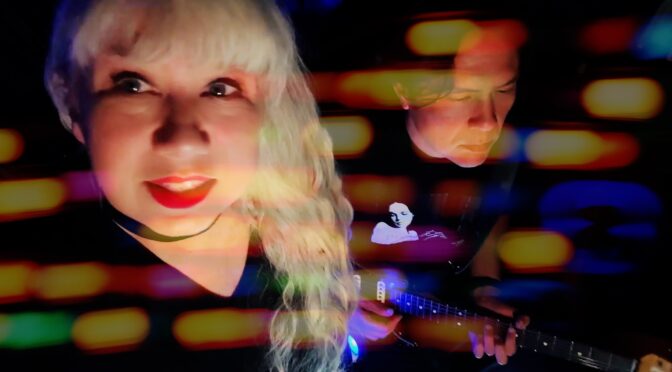
“Each of our albums change. We’re not frozen in place since our first record or anything. And as we progress through life and age and experience different things… you change as people and your aesthetics change a little bit, and your art changes a bit. It still sounds like us. It’s very, you know, pretty and sensual and spacey.”
Ryan Lum spoke those words in March 1998, during an interview on the radio show All-Purpose Nuclear Bedtime Story at KUCI, hosted by Anji Lum — then known as Anji Bee — before she had even dreamed of joining the project. He was discussing Flux, the ambitious, electronics-forward final studio album by Love Spirals Downwards on Projekt Records that marked a decisive turning point in the band’s sound and lineup. But his words could just as easily describe everything that followed: a new singer, a new band name, a new label, more than a dozen albums, remix collections, reissues, collaborations — and now a return to the original name and a singles era introducing the music to a new generation. What remains constant is the core — pretty, sensual, spacey music that evolves with its creators. For years, the shift from Love Spirals Downwards to Lovespirals made that continuity less visible — not only to younger listeners discovering the catalog later, but also to older fans and scene followers who had lost track of Lum’s ongoing work.
Chillcuts: The Engine of Continuity
By the new millennium, the independent music world that had launched Love Spirals Downwards was undergoing a severe transformation. “At the end of the 90s, Projekt fell behind on paying royalties to the artists,” Sam Rosenthal admitted in a December 2019 Projekt blog. “I decided, enough of that! I downsized to just me and Lisa, got out of $180,000 debt owed to pressing plants, credit cards, etc.” The pressure had been building for years. As Rosenthal recalled in a 2014 ProjektList Q&A, “In 1994 Tower owed Projekt $50,000 for Black Tape, Love Spirals Downwards and Lycia CDs they ordered and sold through the stores. Like almost every vendor back then, they were late at paying. Or just flat out refused to pay.” But those 1990s-era pressures were only the beginning: “The hardest was the early 2000s. Projekt had gone deep into debt in the late 90s, and I had to downsize the staff from 10 to 2 to get things under control,” Rosenthal admitted in Obskure (2023). “2002–2007 was a hard time for small labels as unlicensed digital ate away at CD sales.”
In The Big Takeover (2023), Rosenthal captured the scale of the transition from the 1990s physical market to the streaming era: “Back then, there were years where Projekt only had 2 new releases. But back then, a release could be promoted for 6–12–18 months. Those Lycia, and Black Tape and Love Spirals Downwards releases had long legs. Now, the stream wants to be replenished continuously.” In the pre-digital era, that was part of the value a label like Projekt could offer: time, infrastructure, and focused attention for a release to build momentum gradually rather than compete in a constant churn of new content. Promotion was not simply a matter of waiting; it depended on channels that still worked. As Rosenthal recalled elsewhere in The Big Takeover, “Back in the Alternative Press mid-90s era (pre-internet) I suspect the ads were effective at getting the word out. And earlier, I did 1-inch ads in the back of Spin that got 1000+ letters in the mail each time (asking for the catalog). Where is there to advertise that would really make a difference these days?” The new era demanded a different approach entirely — and as Rosenthal put it in Obskure: “There’s no right answer. But there is a wrong answer: Only thinking about what worked in the 1990s, or thinking that one strategy will work for everyone.” As the old label infrastructure contracted, artists had to take a more active role in promotion, direct sales, and audience connection themselves.
Ryan and Anji were already thinking in those terms well before Chillcuts formally took shape. In a 2000 interview with Sean Flinn for RadioSpy Anji’s enthusiasm was unmistakable: “It’s exciting. We’re really excited about Internet audio.” Ryan was equally energized, but more cautious about what digital distribution would mean in practice: “It’s a weird time as far as being a record label and an artist. What’s gonna happen? Will there be CDs in the future? Will the distribution mechanism all be electronic, online? Which way should you go? Who should you place your bets with? I don’t know!” That uncertainty extended to Lovespirals’ relationship with Projekt, with Ryan acknowledging that they were “having some issues” and “different ideas” about “electronic internet distribution” and “downloadable mp3s.” Rather than rush into the wrong arrangement, he explained, “I’m just taking a ‘wait-to-see-what-happens’ approach instead of committing right now and committing to the wrong thing and being screwed.”
Formalizing their existing website, webstore, and online presence into Chillcuts would eventually give Ryan and Anji a flexible vehicle for handling digital distribution directly while still issuing new Lovespirals albums on CD as well as online. In practice, the label operated across both formats: new full-length releases appeared in physical and digital editions, while archival works, singles, and remix material could be released digitally. As online music technologies and listening habits continued to evolve, Chillcuts evolved with them — extending the project’s presence across each new wave of digital culture, from early music sites and online retailers to YouTube, Bandcamp, Facebook, Instagram, and beyond.
The pivotal moment came in 2005 with Free and Easy, the second Lovespirals album and the first original full-length issued on both CD and digital through Chillcuts. Where Windblown Kiss had appeared as a Projekt CD release, Free and Easy reflected a new division of labor: Chillcuts oversaw the release itself, including digital distribution and direct sales, while Projekt continued to support the CD through its Darkwave distribution network alongside the band’s own webstore and other online retailers. That same year, Chillcuts also brought the full Love Spirals Downwards back catalog to digital platforms and storefronts. By May 2005, Idylls, Ardor, Ever, and Flux were all available on digital platforms, making the complete arc of the band’s evolution accessible to listeners for the first time.
That archival commitment only deepened over the following decades. In 2007, Lum remastered Idylls and Ardor from the archival master DATs, adding three previously unreleased tracks to each. The relationship between Chillcuts and Projekt had by then evolved into a practical new division of labor: the reissues appeared on CD through Projekt and digitally through Chillcuts, while the third Lovespirals album, Long Way From Home, arrived in the same period on both CD and digital through Chillcuts, with physical copies carried through Projekt’s Darkwave distribution. That cooperative spirit was visible in Projekt’s own curatorial choices as well. On the label’s 2007 boxed-set compilation Projekt 200 — a three-CD celebration of its 200th release — Projekt included both “Empty Universe” from the then-upcoming Long Way From Home and “Write in Water” from the then-upcoming remastered edition of Ardor, placing current Lovespirals work and the archival Love Spirals Downwards revival side by side under the same commemorative banner.
By 2014, the label shifted focus to long-form archival projects: the Live album (2014) was a compilation assembled from 1990s DAT recordings of performances circa 1995–1997, followed by the Sideways Forest EP (2017), which expanded the 1996 Projekt CD-single with two previously unreleased versions. These efforts culminated in the Ever Remastered Reissue (2020) and the Flux Deluxe Edition (2023). As Chillcuts’ most ambitious projects to date, both releases nearly doubled in length, drawing on remixes, live recordings, and previously unreleased songs. The journey reached a new milestone in 2024, when they partnered with Lost in Ohio to bring the original 9-song version of Flux to vinyl for the first time — finally bringing this seminal work back to its physical roots.
Flux: Archive and Renewal
The archival expansion of Flux also provided an opportunity to document the project’s evolution. The original 1998 album marked a decisive pivot toward electronics and drum & bass, while also making visible a shift in how the project was being shaped. Ryan described the record in a 1998 KUCI interview as the result of a long, iterative process in which songs were tested, discarded, and gradually clarified: “I had a few songs that I tossed away this time. There were some songs that just didn’t quite click.” He added, “Flux, I was probably working on maybe a year before the idea solidified and I saw what the end result was gonna be. I was just kinda trying different things.” Perry described that same shift in Fix Magazine that same year: “Usually it’s more of a collaborative effort, but he took it in directions that I wouldn’t necessarily have gone if I was there at every moment. It’s more of Ryan’s work. It’s something that he fashioned out of his own likings.” Seen in that light, the Flux Deluxe Edition does more than expand the archive: it reopens a moment when the project’s center of gravity was already moving toward Lum’s studio-led process. The reissue’s inclusion of early vocal experiments and abandoned directions is valuable because it documents that process in motion.
The Flux Deluxe Edition marked a turning point beyond the archival. Included was a new recording of “I’ll Always Love You” — renamed “Misunderstood” to better reflect its sole repeated lyric — as the project’s emotional centerpiece. As Ryan explained in a YouTube feature on the reissue, the origins were serendipitous: rediscovering some of the original audio files — particularly the bass — in his archive, he pulled them into his DAW and found himself reinterpreting the song alongside Anji with fresh ears and new tools — “keeping true to the spirit of the original song and putting our own new unique interpretations into it.“
The response to “Misunderstood” suggests that listeners heard it not as an archival footnote, but as a fully contemporary extension of the Love Spirals Downwards aesthetic. While the archival original mix included in the Flux Deluxe Edition garnered just 35,000 streams and the 1998 original version sits at 320k, the new recording has already surpassed 625k — placing it among Love Spirals Downwards’ five most-streamed songs on Spotify. That a newly reimagined version of a nearly 30-year-old composition has nearly doubled the original’s stream count in a fraction of the time suggests not only the song’s durability, but the extent to which modern listeners are hearing this version as present-tense Love Spirals Downwards.
From Reissue to Renewal
Just weeks after the Ever Remastered Reissue appeared in July 2020, Lovespirals released “Why Not Today?,” a melancholic, dreamy Bandcamp exclusive that brought their neo-soul sensibility back into view. Later that year, they turned toward more experimental and ambient territory through contributions to Projekt’s tribute album Tim, where are you now?, reconnecting with the wider label community on “Starseed,” with Sam Rosenthal and Forrest Fang, and “PSY PHI love means High Fidelity,” alongside Rosenthal, Byron Metcalf, and Martin Bowes.
By 2022, the duo’s newer work had begun to assume a clearer shape. The three-track Smile single reflected a new mode of working, with pandemic-era studio experiments now finding release in more deliberate form. Its title track paired shimmery shoegaze textures with a laid-back beat, while “Down Low” brought a jazz-inflected K-indie feel and a rare backing vocal from Ryan. The set also included a new mix of “Why Not Today?,” folding its earlier Bandcamp appearance into a wider release.
Bandcamp reviewer Conchita captured the continuity beneath these stylistic shifts: “Ryan’s unique sound gets even better with each new record if that is at all possible. You know how Santana, Vai or Satriani have their own sounds that you recognize straight away? Well, same goes for Ryan. A real treat to the senses.” What persisted across each turn in style was the unmistakable stamp of Ryan Lum’s musical personality. His melodic instinct, emotional phrasing, and atmospheric sense of texture provided a through-line connecting the Projekt years to the Lovespirals era and beyond.
“The Call” followed in July, moving into darker and more dream pop-centered territory, its goth-tinged guitar hook and lush solo sharpening the transitional mood into something more defined. Two months later, “Lonely Sunset” turned again, this time toward chill house, with ethereal vocals suspended over bittersweet melodies and electronic textures.
The year 2023 brought two more significant markers. The Flux Deluxe Edition — including the new recording of “Misunderstood” — marked the first clear convergence of the band’s two names. Then, in November, the duo completed a remix of Alan Elettronico’s “This Ain’t Love” for Projekt’s Electric Mind (Deluxe Edition). Reflecting on the track on Chillin’ with Lovespirals #90, Ryan said: “I think this is the best remix I’ve ever done in my life… it got our momentum going production-wise, which led to why I think ‘Noumenon’ sounds, in my opinion, like one of the best productions I’ve ever made.”
Noumenon: The Thing Itself
In June 2024, Love Spirals Downwards released “Noumenon (feat. Lovespirals)” — a title that encoded the band’s split identity directly into the metadata. That dual-identity approach extended to Bandcamp, where Lum maintained two separate storefronts, one branded as Lovespirals and the other as Love Spirals Downwards, uploading the new single to both in order to reach each audience within its familiar corner of the catalog. It was a practical bridge, but also a revealing one: the same creative force, long divided between two names, was beginning to converge in public.
The song itself made that convergence audible. Moving through atmospheric electronica, trap-influenced beats, and dramatic guitar textures, “Noumenon” showed Ryan Lum continuing to work across genre lines without losing the distinctive character of his music. Anji’s airy, sensual vocal carries the refrain “Love is just a noumenon,” drawing on the Kantian idea of the thing-in-itself — the unknowable reality beneath perception. The Bandcamp description framed the release in similarly expansive terms, presenting it as further evidence that Lum’s creative evolution remained ongoing.
In July 2024, the “Noumenon (Drum n’ Bass Mix)” followed on streaming platforms, while Bandcamp received an exclusive three-track single that included a “Guitar Focus Instrumental.” The response suggested that the bridging strategy was doing more than solving a metadata problem. In a Bandcamp review, AJ Hughes wrote: “Not having followed Ryan Lum’s continuation as Lovespirals, my interest piqued when ‘Noumenon’ was added to the LSD collection. Seems to draw from the beautiful pedigree of Flux… Lum’s songwriting abilities have sharpened in the interim. Excited to explore what I have been missing.”
Two Names, One Project
The momentum continued to build. “Not Myself (feat. Lovespirals),” released in September 2024, extended the parallel branding first established with “Noumenon,” continuing to bridge the two identities for listeners on either side of the catalog divide. A return to early-2000s chillout textures, the track combines soft beats, ambient layers, and lightly jazzy guitar with minimalist lyrics that loop like a mantra: “I don’t know who I am / But I know I’m not myself.”
Its reception suggested that the approach was reaching well beyond existing fans. With over 600,000 Spotify plays and a Worldwide FM Future Bubblers feature on January 30, 2026, “Not Myself” became the band’s third most-streamed song on the platform. Introducing it on air, host OKCandice referred to “the wonderful Love Spirals Downwards with ‘Not Myself,’” nodded to “the new iteration of Lovespirals,” and joked that there was “a lot of spiralling love going on at the minute” — an offhand remark that nonetheless captured how naturally listeners and tastemakers were beginning to hear the two names as parts of one evolving project.
Two months later, “Used to Be” deepened the emotional register. Blending dream pop and electronica with ghostly vocals and cinematic sweep, the track builds from a goth-tinged guitar hook toward an expansive solo, while Anji’s voice moves between grounded and ethereal as the lyrics linger on the difficulty of returning to ordinary life after prolonged isolation: “Life returned to how it used to be / Days filled with nothing and nobody.” On Chillin’ with Lovespirals #93, Ryan described it as “off in that sad, beautiful direction,” while Anji observed that it “wouldn’t sound out of place with ‘The Call.’”
It was also the release that exposed the limits of the parallel-branding strategy. Although the metadata carried the full Love Spirals Downwards name, the artwork still used the modern one-word Lovespirals logo — a mismatch that ran afoul of Apple’s updated style requirements and led to the single’s rejection. As Anji explained on Chillin’ with Lovespirals: “They wouldn’t even allow ‘Lovespirals’ on the artwork. It’s been a nightmare.” Ryan was more direct: “It’s been kind of a pain in the ass to have two separate ‘bands’ when I’ve been doing the same stuff continuously since 1990, basically. I haven’t stopped.”
What began as a bureaucratic frustration gradually clarified the larger direction of the project. The Love Spirals Downwards Bandcamp Pro account — already established for the Flux vinyl campaign — made it possible to place Lovespirals-branded releases alongside the archival catalog, bringing the history together on their own terms. On the major streaming platforms, however, the logic of maintaining two parallel identities had begun to give way. Rather than reading as a separate chapter, the Lovespirals years now appeared more clearly as part of a longer creative continuum that was reconverging under the Love Spirals Downwards name.
Embracing the Full Name
The decision to revive the full Love Spirals Downwards name wasn’t made in a vacuum, nor was it simply a matter of platform compliance. By the mid-2020s, the name was perceived differently than it had been in the 1990s. Where Love Spirals Downwards had once been associated more with the gothic-leaning audience of Projekt, a new generation of listeners was encountering it with fewer preconceptions. To them, the name carried only what the music itself communicated: pretty, sensual, atmospheric, timeless.
The vinyl reissue of Flux told part of that story in the most tangible terms. Released on limited edition white vinyl through Lost in Ohio in April 2024 — using the remastered audio Ryan had prepared for the Deluxe Edition — it sold out, prompting a second pressing in September 2024 that sold out in turn. An eco color-swirl pressing followed a year later. That is sustained demand across 18 months, unfolding in parallel with the monthly singles campaign, as archival and current work built momentum together.
What mattered was not simply that Flux was being praised again in the 2020s, but how it was being rediscovered: through DJs, streaming sets, curators, niche radio, and younger artists hearing it as a living text rather than a relic. Between 2022 and 2025, DJs including Avalon Emerson, Bored Lord, and DJ Estoc folded Flux tracks into Apple Music sets, while NTS Radio continued its long-running engagement with the catalog, culminating in a dedicated In Focusfeature in March 2024. In 2024, that renewed circulation became especially visible in an exchange between two Gen-Z tastemakers: after music curator marg.mp3 had praised the original album to her TikTok following, Erika de Casier named Flux without hesitation as the last album that had really stuck with her, calling it “a beautiful album” and singling out its blend of drum and bass and ethereal vocals. By 2025, Princess P.’s Infinite Sonore vinyl compilation was positioning “Sunset Bell” from Flux alongside acid house, IDM, and minimal wave rarities as part of a broader lineage of electronic dream music.
Releasing new music as Lovespirals had created an unintended disconnect. Younger listeners discovering Flux generally had no idea Ryan Lum was still actively making music, or that his newer work with Anji was continued the same long-running dialogue between ethereal dream pop and contemporary electronica. Even longtime scene listeners could miss the connection. Writing about “Dissociate” in May 2026, I Die You Die admitted, “despite having a lot of affection for US ethereal darkwave act Love Spirals Downwards, we weren’t aware that the duo of Ryan and Anji Lum were putting out new singles in 2026.”
Bridging the Eras: VIP Mixes
With the name question settled, Ryan and Anji chose a more gradual approach. Rather than immediately launching new material under the Love Spirals Downwards name, they revisited two songs from the Lovespirals catalog and reintroduced them as newly reimagined VIP mixes. It was a bridge between eras as much as a creative exercise.
“The Call (VIP Mix)” released in February 2025 revisited their 2022 single with a moodier, more atmospheric reboot — amplifying the shoegaze and dream pop essence with a bigger, bolder guitar sound and more immersive ethereal vocal harmonies. Ryan broke down the sonic architecture on Chillin’ with Lovespirals #94:
“It’s so ’90s. One guitar panned on the right sounds like a cross between Robert Smith of The Cure with something that’s more like a shoegazer kind of thing, and then another guitar panned left is like this overdriven wall of sound with loads of modulation.”
Anji added: “Maybe one of the most shoegaze guitar sounds you’ve ever gotten, to be honest.” Reviewer Brandon Isleib of Restless Mosaic captured the paradox neatly: “It’s shoega[U]zier and clearer-sounding than the original at the same time. That’s no mean feat!“
“Will It Ever Be The Same (VIP Mix)” released April 2025 reached further back, revisiting a track from the 2018 album Life Goes On that had slipped through the cracks on its original release. As Anji reflected on Chillin’ with Lovespirals #95: “It’s hard when you have a nine, ten song album. Some of them got music videos and some didn’t. This one kind of slipped through the cracks.” Ryan saw the remix as a genuine reinvention: “We’ve gotten better as musicians and producers. We took it to a whole new level — it really kind of is a brand new song.“
The Flux Influence Lives On
In the third week of September 2025, three things happened in quick succession: the announcement of a Flux color-swirl vinyl pressing, the release of “Molten (Love Spirals Downwards Remix),” and, just twenty-four hours later, the arrival of “Nothing Even Matters Anymore.” It was a busy week, but also a revealing one: the past and present of Love Spirals Downwards had rarely felt more intertwined.
The “Molten” remix came about when electronic duo Blue Ringed Baby + Kami invited Ryan to reimagine a track from their album Forever Chemicals, released via GODDEZZ. As they explained in an interview with Hue & Saturation, they were: “huge fans of Flux and how it blended hazy shoegaze guitars, soft vocals with dnb breaks back in the ’90s.” Isaw the remix as a way of making that lineage legible to younger listeners. For Ryan, the experience was its own kind of return. “When I was making it I go, ‘Wow, I feel like I’m back!’” he said on Chillin’ with Lovespirals #99. “It really took me back to a ’90s headspace of making Flux.”
In miniature, the remix captured the broader dynamic surrounding the catalog in the mid-2020s: a younger generation was not only discovering Love Spirals Downwards, but building on its vocabulary in real time. The response to the remix also suggested a sense of delighted surprise. NTS host RuF Dug called it “Gorgeous,” while Shai FM joked, “Sooo good. I did not have a Love Spirals Downwards remix on my bingo card for this year.”
The Streaming Generation
Between 2024 and 2025, Love Spirals Downwards’ Spotify listener base nearly doubled, rising from 348,000 to 662,000, while total streams climbed from 2.5 million to 4.4 million. By the first quarter of 2026 alone, they had accumulated 1.6 million streams with active listeners reaching an all-time high of 66,000. Most striking of all, 79 percent of the audience fell between the ages of 18 and 34 , while the band’s own age cohort accounted for just 3 percent of listeners. It was a quietly remarkable inversion: music made by veterans of the ’90s underground was discovered and claimed by a generation for whom it sounds not like nostalgia, but like something genuinely new. As Ryan observed on Chillin’ with Lovespirals #95: “There’s a whole new generation that’s just found us.” By that point, the bridge had been crossed: all future new music would move forward under the Love Spirals Downwards name.
The Algorithm Era: Singles Over Albums
With the name question resolved and the Spotify numbers continuing to rise, Ryan and Anji committed to a disciplined release strategy: one single per month. It was a practical response to the streaming era, but it also became an artistic form in its own right. Rather than disappearing for years and returning with a completed album, the duo began unveiling a new body of work track by track, in real time.
What emerged across the monthly campaign was consistency of voice without uniformity of approach: the singles moved between dream pop, downtempo electronica, neo-soul, chillout, and darker late-night atmospheres, each extending the project’s emotional and stylistic range in a different direction. The format suited the platforms, but it also gave the duo room to let a larger work reveal itself gradually, one song at a time.
The campaign opened in May 2025 with “Boss Mode,” an intimate blend of neo-soul, introspective dream pop, and soulful electronica — confident, unhurried, and quietly expansive in its emotional range. Okay” followed in June, merging sensual modern R&B grooves with haunted dream pop textures; with more than 225,000 Spotify streams, it quickly became one of the clearest early signs that the monthly strategy was gaining traction. August brought “Glittering,” a shimmering return to chillout that drew on the hypnotic allure of millennial downtempo electronica while remaining fully within the duo’s dream pop vocabulary.
By early fall, the campaign had already begun to show how wide a territory the project could occupy. September’s “Nothing Even Matters Anymore” pulled in a different direction — rooted in Projekt-era beginnings yet alive with the immediacy of the present, its gothic-tinged ebow and distorted guitar textures carrying an unmistakably early ’90s feel while its existential resignation echoed the emotional terrain of “Noumenon.” October’s “Without You” pivoted again, unfolding as a lush, soul-baring ballad shaped by classic neo-soul warmth and smooth sophistication; with more than 200,000 streams, it joined “Okay” as one of the campaign’s strongest performers. December’s “Drift Begins” closed out the year on an atmospheric note, casting a nostalgic spell that nodded toward dark wave textures while opening onto new emotional horizons.
The 2026 singles deepened the thread rather than merely extending it. In January, “Gray” drew explicit sonic and emotional connections to “Noumenon” and “Nothing Even Matters Anymore,” continuing the band’s exploration of emotional dislocation and restraint while carrying forward some of the downtempo gravity of “Glittering.” February’s “Secrets” turned inward, its hushed late-night atmosphere shaped as much by restraint as confession, leaning away from guitar-led dynamics in favor of moody synthesizers, understated keyboard lines, and contemporary electronic beats.
March’s “No Reply” returned to the soulful late-night side of their sound. Opening with the melancholic sound of rainfall before Ryan’s haunting piano motif and floating strings establish the mood, the track unfolds with what reviewer Karl Magi described as “a velvet flow” that “glimmers with sunset light,” while Anji’s “beautifully gentle voice carries a levitating melody,” wrapping around the listener “like a warm blanket despite the hurt within the lyrics.” The song traces one of the campaign’s clearest emotional arcs: from suspended uncertainty — “Did you leave me on read just to get into my head?” — toward a quiet but decisive release, “block and move on, now I’m free.”
“Dissociate,” released on Bandcamp Friday, May 1, 2026, pushed the unfolding project into its darkest late‑night territory yet: sparse, hypnotic beats and shimmering guitar framing Anji’s fragile whisper as a 2 AM refuge when the world is too much. In their write‑up, I Die You Die noted, “The lush production, sweet and understated delivery and chill groove are all things that have defined the band’s output.” The Italian Sireneil Podcast called it “more than a song: a small inner refuge, a half-remembered dream, an invitation to find peace in the silence of the night,” emphasizing the way Ryan and Anji continued to carry the Love Spirals Downwards project forward through a delicate balance of programming, guitars, vocals, and mastering.
As the realities of the streaming and algorithm-driven landscape became clearer — and as CDs and traditional album cycles gave way to singles, playlists, and continuous visibility — the one-per-month made increasing sense. Projekt founder Sam Rosenthal had already captured the new logic succinctly in The Big Takeover in 2023: “Now, the stream wants to be replenished continuously.” Ryan and Anji’s monthly campaign answered that reality directly, while turning it into an artistic method of their own. On Chillin’ with Lovespirals #93, Ryan summed up the shift away from the classic “disappear for years, return with an album” model—“I like this kind of regular release thing instead of making people wait two years or whatever for an album. It’s stupid.” Anji framed the same adjustment more gently, explaining that they were “just trying to learn” in a world where “everything is so different with music these days.”
In practice, the monthly strategy became both practical and philosophical: rather than disappearing for years between album cycles, the duo stayed in constant conversation with their audience, releasing songs as they were finished and pairing each one with videos, podcast commentary, and related material across platforms. In this new era, Ryan and Anji weren’t just putting out tracks; they were gradually building a new album in public, one single at a time.
Video and Visibility: YouTube Strategy
A crucial component of the duo’s monthly release strategy was YouTube, where they had long maintained two separate channels. The Lovespirals Official channel housed vlogs, interviews, and music videos for current work, while the Love Spirals Downwards channel remained largely archival. That arrangement began to shift in 2023 with promotional videos for the Flux Deluxe Edition, including a chat with Ryan about the album’s creation and new music videos by Anji for several of the reissue’s bonus tracks.
The need for a more unified presence became especially clear in 2024, when Ryan posted a video of himself jamming live over “Nova” in the studio. A comment from xgmb45 — a fan who had discovered the band through RateYourMusic — captured the disconnect with unusual clarity: “I’m so happy to see you’re still active… What are you doing with yourself these days, Ryan?” The question was innocent, but revealing. Even listeners actively seeking out Love Spirals Downwards material did not always realize that Lum’s work had continued under the shortened Lovespirals name.
The answer arrived shortly with the music video for “Noumenon.” Filmed and edited by Ryan, the video combined low-lit in-studio performance footage with the glowing neon imagery of the single’s cover art, and, crucially, it was posted to both channels. It also inaugurated a run of monthly visual releases that helped reconnect the archival and contemporary sides of the project. The reactions on the Love Spirals Downwards channel immediately drew parallels between eras. One listener posted, “Sweet you two. It’s like a mix of the first Lovespirals album blended with the last LSD album and a good dose of the first 2 LSD albums. I like the new moody direction!” Another added, “This is awesome, great song! Anji’s voice fits the LSD style perfectly.” On the Lovespirals Official channel, the reaction was less comparative and more immediate: listeners accepted the new material as a natural continuation of the duo’s present-tense work, with comments like “There’s that angelic voice we love so much!” and “Another great song. Good to see Ryan playing guitar.”
The comments beneath later uploads revealed the audience’s generational breadth in miniature. Beneath “No Reply,” one longtime listener reflected, “I’ve been a devout fan since the early days of LSD. It has such a nostalgic feel for me. It’s an intensely personal retrospective journey every time I hear that signature sound. No other group comes close. Always amazing work. Ryan is a true genius in his craft.” Beneath “Gray,” a listener who had discovered the band only days earlier marveled, “Ohhh you guys are doing new songs??? That’s wonderful!!” Another commenter echoed the sentiment, adding: “really happy to hear it! yea old good wibes idylls and ardor. more please more!” Beneath “Dissociate,” a viewer from Ukraine wrote that she had stumbled across the band by chance and found several albums quickly rising to the top of her personal playlist. Younger listeners registered the continuity just as naturally: one, born in 2005, wrote, “So awesome to see you making new music,” while another noted having first encountered the music through their parents. By this point, the channel was doing more than hosting videos. It was making visible a cross-generational audience learning, in real time, that the music’s past and present still belonged to the same unfolding story.
Broadcasting the Process
Central to this community engagement is the Chillin’ with Lovespirals podcast. Originally launched in 2005 as one of the first music-related podcasts on the internet, the show chronicled the band’s progression through 2011 before shifting focus toward social media. After a brief video return in 2018 to promote Life Goes On, the show’s full-scale comeback in 2023 transformed it into a genuine multi-platform hub. Now available on Spotify, Apple Podcasts, Amazon, and YouTube—with supplemental clips across TikTok and Instagram—it serves as the duo’s direct line to their global audience.
The show functions as both a living archive and a real-time production diary. As Anji noted: “Go back and listen to the old episodes. I found it fascinating — hearing about how we felt about things as they were developing.” For Ryan, the show is a way to navigate an ever-shifting landscape: “We keep existing through time and times are changing. Music technology, internet technology, how to distribute our music… it’s all evolved.”
The podcast builds a uniquely personal connection, allowing Ryan to share the intimacy of the creative process: “When we’re working on a song here, it’s very private, very personal. It’s something that belongs to us and no one else has even got a whiff of it.” This transparency creates a feedback loop of genuine excitement. When fans began predicting that Used to Be would be “another banger,” Anji shared the sentiment: “That made me so excited, because we’re so excited to share new music with you.“
Beyond the studio, the show celebrates the ecosystem that sustains independent music. They frequently shout out support from indie radio staples like Big Sonic Heaven, Soma FM, and Eardrum Buzz Radio. As Anji summarized on Chillin’ with Lovespirals #93:
“It’s just so great that the music is actually reaching people’s ears. That’s really the goal here. We make a song that we fall in love with and we hope that you guys can hear it and maybe fall in love with it too.”
Evolution Spiralling Without End
Ten singles in ten months. The catalog was growing, the audience was growing, and Love Spirals Downwards — under the direction of founding member Ryan Lum — were locked into a remarkable creative rhythm. But more than the numbers, it is the continuity that defines this era.
From a 1998 radio interview to a 2026 Spotify playlist, Ryan and Anji Lum have moved through sweeping changes in the music industry without losing their sonic north star. When Ryan spoke in the late ’90s about not being “frozen in place” and about allowing his art to change as he “progressed through life and age,” he was already describing the logic of this later resurgence: music that evolves alongside its creators while remaining anchored to an unmistakable core.
Whether the listener is a devout fan from the 1990s or someone born in 2005, the response points to the same recognition. As the philosophical language around “Noumenon” suggests, perception may shift across time and context, but the music of Love Spirals Downwards still arrives with the qualities Ryan once named nearly thirty years ago: pretty, sensual, and spacey. In that sense, the project has not simply returned. It has continued.