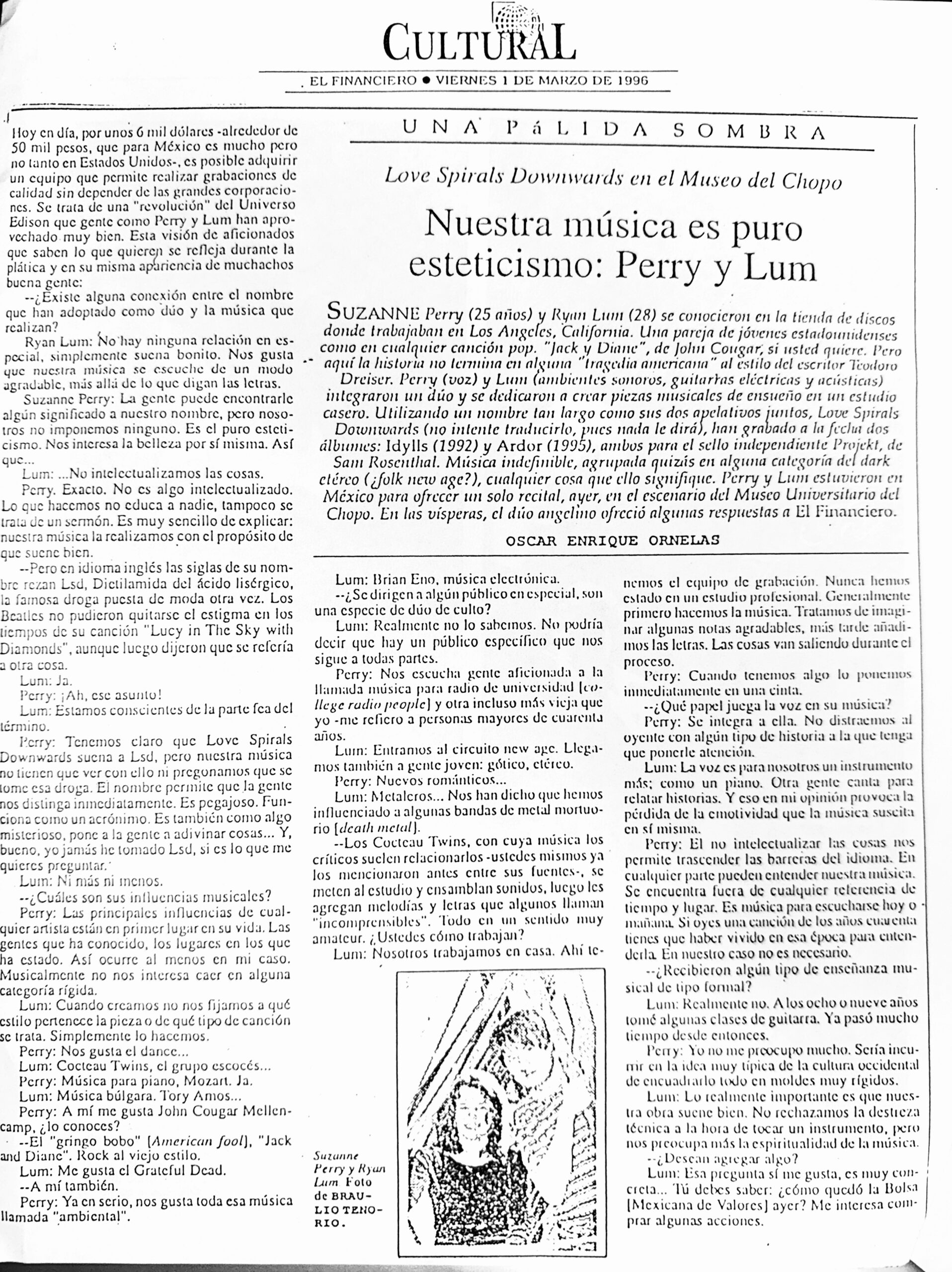
The band were interviewed by one of the major newspapers in Mexico, El Fianancerio, after their headlining concert in Mexico City. Appearing in the Cultural section of the primarily business and financial news focused paper, the article is titled “A Pale Shadow.” Below is a translation from the original Spanish with slight formatting changes to indicate the speaker. A scan of the clipping faxed over to Projekt follows.
Love Spirals Downwards at the Museo del Chopo
by Oscar Enrique Orneleas
Suzanne Perry (25 years old) and Ryan Lum (28) met in the record store where they worked in Los Angeles, California. A pair of young Americans, like any ordinary couple. “Jack and Diane,” by John Cougar, if you know what I mean. But here the story doesn’t end in an “tragedia Americana”—it’s the style of the writer Theodore Dreiser. Perry (voice) and Lum (various sounds, electric guitars and synthesizers) have integrated their home studio and create pieces as varied as any of the records they listen to. Using a longer name with their two last names together, Love Spirals Downwards (don’t try to translate it, it’s more complicated than it seems), they have two albums: “Idylls” (1992) and “Ardor” (1995), both released on the independent label Projekt, begun by Sam Rosenthal. Ethereal music, guided by the ancestral catalog of dark and ethnic music (“folk” at one time), anything you can imagine. Perry and Lum were in Mexico to offer one solo recital yesterday, on the stage of the University Museum of Chopo. In the evening, this same duo offered some answers to ‘El Financiero’.
Today, for about 6 thousand dollars—around 50 thousand pesos, which for Mexico is a lot but not so much in the United States—it is possible to acquire equipment that allows you to make quality recordings without depending on large corporations. It is a “revolución” of the “Universo Edison” that people like Perry and Lum have taken very good advantage of. This vision of enthusiasts who know what they want is reflected during the conversation and in their very appearance as “muchachos buena gente.”
OSCAR: Is there any connection between the name you’ve adopted as a duo and the music you make?
LUM: No, there isn’t any special connection; it just sounds nice. We like our music to sound pleasant, independent of what the lyrics might say.
PERRY: People try to decipher a meaning in our name, but honestly, there isn’t one. It’s pure aestheticism. Beauty matters to us for its own sake.
LUM: We don’t intellectualize things.
PERRY: Exactly. It’s not something intellectualized. What we do doesn’t aim to educate anyone or deliver any kind of sermon.
OSCAR: But in English the initials LSD are the same, right?
LUM: We never even noticed that; it’s just a coincidence.
PERRY: Exactly. We’re aware that Love Spirals Downwards sounds like “LSD” to some people, but our music isn’t meant to “alter consciousness” or be psychedelic. It’s just music with an emphasis on beauty and feeling.
LUM: Maybe you’ve heard that song “Jack and Diane”? It’s kind of the same idea—ordinary people interpreting things their own way.
PERRY: The name lets people distinguish us immediately. It’s catchy. It acts like an acronym. It’s also a bit mysterious—it makes people guess at meanings. Well, I’ve never taken LSD, if that’s what you want to ask me.
OSCAR: What are your main musical qualities?
PERRY: Sincerity and honesty. For us, music is about expressing ourselves, not about following trends. We do what we feel.
LUM: Our main quality is that we never pretend to be someone we’re not. We’re not interested in technical perfection or impressing anyone—we care about emotion.
OSCAR: Do you have any specific musical ambitions?
PERRY: No, just to keep making music, honestly. We aren’t aiming for fame or anything, as long as we can keep expressing ourselves.
LUM: Our only ambition is to be honest in our music. Sincerity is our measure of success.
OSCAR: And what are your musical influences?
LUM: We don’t really dwell on influences, but we do listen to ambient music, Brian Eno, and a lot of electronic music.
PERRY: We also like the Grateful Dead.
LUM: Yes, we enjoy what’s called “ambient” music.
PERRY: The biggest influence on any artist comes first from your life—the people you’ve met, the places you’ve been. That’s what happens, at least in my case. Musically, we don’t care to fit into any rigid category.
LUM: When we create, we don’t worry about what style or genre it is. We just do it.
PERRY: We like dancing.
LUM: Cocteau Twins, the Scottish group…
PERRY: Piano music, Mozart—ha!
LUM: Bulgarian music. Tori Amos…
PERRY: I like John Cougar Mellencamp, do you know him?
OSCAR: (As an unspoken aside) The “gringo bobo” (American fool), “Jack and Diane”—typical American rock.
LUM: I like the Grateful Dead.
OSCAR: Do the Cocteau Twins influence you?
LUM: Yes, we admire them, their minimal arrangements, their use of textures.
PERRY: Their way of composing, layering different sounds, then letting them come together. After the music comes together, they add vocals. Some people call our music “amateur,” but we take it very seriously at home.
OSCAR: How do you create your music?
LUM: We work at home and use our own recording equipment. We’ve never worked in a professional studio. We generally make music together at home.
PERRY: We try to make things enjoyable, but most of the time the lyrics come out during the process. It’s not something we meticulously plan.
LUM: When we have something ready, we record it straight onto tape.
OSCAR: Do you direct your music toward anyone in particular? Is it meant for a cult following?
LUM: Actually, we don’t know. We couldn’t say that there’s a specific audience we target with our music.
PERRY: Most of the people who listen to us are fans of university radio or people with eclectic tastes. I’m not referring only to young people—there are also people over 40 who listen to our music. We really do get listeners of all ages.
LUM: We get listeners of all ages, but it’s usually a younger audience—gothic, eclectic, that sort of thing.
PERRY: New Romantics as well.
LUM: Metalheads… We’ve been told we’ve influenced some metal bands, especially those into doom metal and death metal.
OSCAR: What role does the voice play in your music?
PERRY: For us, the voice is just another instrument, like the piano or guitar. Sometimes it’s used to carry melody, sometimes simply as an element of sound—another color within the music.
LUM: We don’t see the voice as separate or above everything else. It’s not meant to dominate; it blends with the other instruments to create atmosphere and feeling.
PERRY: Usually, the lyrics come after the music is completed. I focus on the sound of the words, their rhythm and how they blend into the music more than on storytelling.
LUM: It’s more about musical texture than explicit meaning.
OSCAR: Have you had any formal musical education or training?
LUM: Not really. When I was about eight or nine, I took some guitar lessons, but that was a long time ago.
PERRY: We consider ourselves self-taught musicians. We develop our sound by trial and error rather than traditional methods. I don’t worry much about technical training. It would be limiting to frame everything according to the very rigid molds typical in Western culture.
LUM: What really matters is that our playing sounds good. We don’t reject technical skill when it comes to playing instruments, but we’re more focused on the spiritual aspect of music.
OSCAR: Do you sing in English by choice, or because of other reasons?
LUM: It’s mostly by habit and comfort, since English is our native language. It just feels natural for us.
PERRY: We haven’t thought much about singing in other languages. Sometimes it comes up, but mostly we focus on making the music sound right.
OSCAR: Do you ever experiment with other languages in your music?
LUM: Occasionally, but not often. Our priority is always the sound and mood of the song rather than the language.
PERRY: Plus, singing in English allows the lyrics to be understood more widely, which is something we appreciate.
OSCAR: Do you feel your music fits into the ambient or dream pop genres? How do you categorize it?
LUM: We don’t really focus on genres. Labels are useful for stores and marketing, but we create from feeling, not classification.
PERRY: People have described our music as “dream pop” or “ethereal,” and that’s fine. We’re happy if the music creates a mood and connects emotionally.
OSCAR: How do you describe the atmosphere or mood you try to create with your music?
PERRY: We aim to create something immersive, lush, and emotional. The music should evoke feelings of calmness, reflection, and sometimes melancholy.
LUM: It’s about textures and space, letting the listener be drawn into the soundscape. We want people to feel surrounded by the music rather than just hearing it.
OSCAR: How do you see your relationship with your listeners?
PERRY: We hope to invite them into a personal, intimate space through our music. It’s not about spectacle or performance—it’s about creating an atmosphere.
LUM: We want people to feel comforted or transported when they listen, something beyond just entertainment.
PERRY: Our music exists outside of any particular time or place. It’s music to be listened to today or tomorrow. When you hear a song from a certain era, you usually have to have lived through that time to fully understand it. With our music, that’s not necessary.
OSCAR: How important are visual elements, like album art or live presentations, for your music?
LUM: Very important. The visuals help set the mood and enhance the listener’s experience.
PERRY: We try to create a cohesive aesthetic that complements the music, something that can evoke feelings even before the music plays.
OSCAR: Do you plan to perform live often?
LUM: We’re not focused on playing live extensively. Our main passion is composing and recording music.
PERRY: Live shows are challenging for us because our music relies so much on studio layering and atmosphere.
OSCAR: Any message you want to give to your listeners?
PERRY: Just to enjoy the music in their own way. We don’t want to impose interpretations or meanings.
LUM: Music should be personal and open to each listener’s feelings.
OSCAR: Thank you for sharing your insights.
LUM AND PERRY: Thank you!
OSCAR: Would you care to add something?
LUM: I like that question—it’s very concrete. You should tell me: how did the Stock Exchange (Méxicana de Valores) do yesterday? I’m thinking about buying some shares.